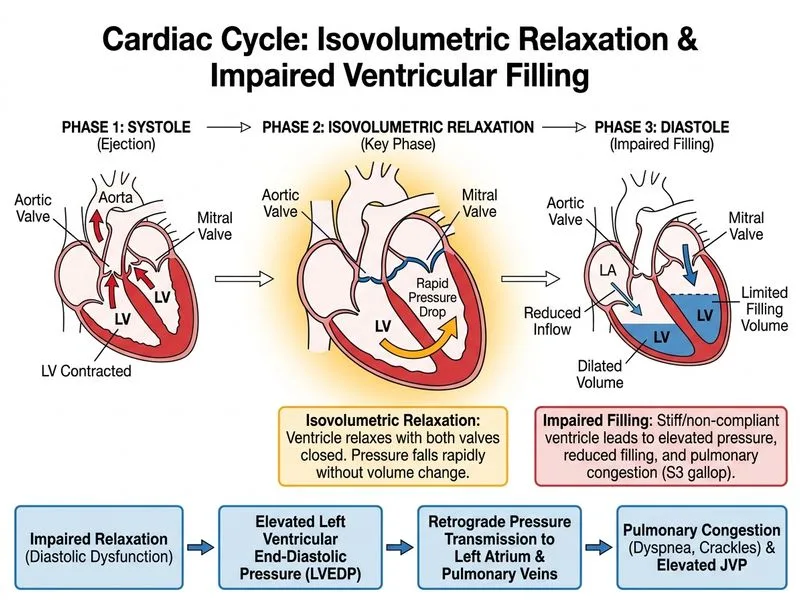
## Clinical Context This patient presents with acute decompensated heart failure (HF) with reduced ejection fraction (HFrEF). The dilated left ventricle, low ejection fraction, elevated JVP, and pulmonary edema indicate systolic dysfunction with impaired diastolic function. ## Pathophysiology of the Cardiac Cycle in HFrEF **Key Point:** In systolic HF, the primary defect is impaired ventricular contraction during the ejection phase, but the clinical manifestations (elevated JVP, S3 gallop, pulmonary edema) are consequences of impaired diastolic function — specifically abnormal isovolumetric relaxation and ventricular filling. ### Why Isovolumetric Relaxation is Affected In HFrEF: 1. **Delayed relaxation**: The failing ventricle has prolonged isovolumetric relaxation time due to impaired active relaxation (lusitropia) and increased chamber stiffness. 2. **Elevated end-diastolic pressure**: Because the ventricle cannot relax normally, diastolic pressures rise, causing: - Elevated left ventricular end-diastolic pressure (LVEDP) → transmitted backward to left atrium and pulmonary veins → pulmonary edema - Elevated right ventricular diastolic pressure → elevated JVP 3. **S3 gallop**: Occurs in early diastole (rapid filling phase) when the stiffened, dilated ventricle abruptly halts further filling, creating a palpable vibration. **Clinical Pearl:** The S3 gallop in HF is a hallmark of diastolic dysfunction superimposed on systolic dysfunction. It represents the ventricle's inability to accommodate blood volume during the rapid filling phase. ### Why Other Phases Are Not Primary | Phase | Status in HFrEF | Clinical Outcome | |-------|-----------------|------------------| | **Isovolumetric contraction** | Prolonged but not the primary clinical driver | Reduced stroke volume results, but elevated filling pressures are the main problem | | **Rapid ejection** | Severely impaired (low EF = 28%) | Reduced cardiac output, but backward failure (pulmonary edema, JVP elevation) dominates the clinical picture | | **Atrial systole** | May be lost if AF develops, but not the primary defect here | Contributes to filling but is not the main cause of the current presentation | **High-Yield:** In HFrEF, systolic dysfunction (weak ejection) is the PRIMARY pathology, but DIASTOLIC dysfunction (impaired relaxation and filling) is the PRIMARY CLINICAL DRIVER of symptoms (dyspnea, edema, elevated JVP). ## Summary The elevated JVP, pulmonary edema, and S3 gallop all reflect impaired isovolumetric relaxation and abnormal ventricular filling due to increased chamber stiffness and elevated diastolic pressures — not acute loss of contractility during systole. 
Sign up free to access AI-powered MCQ practice with detailed explanations and adaptive learning.