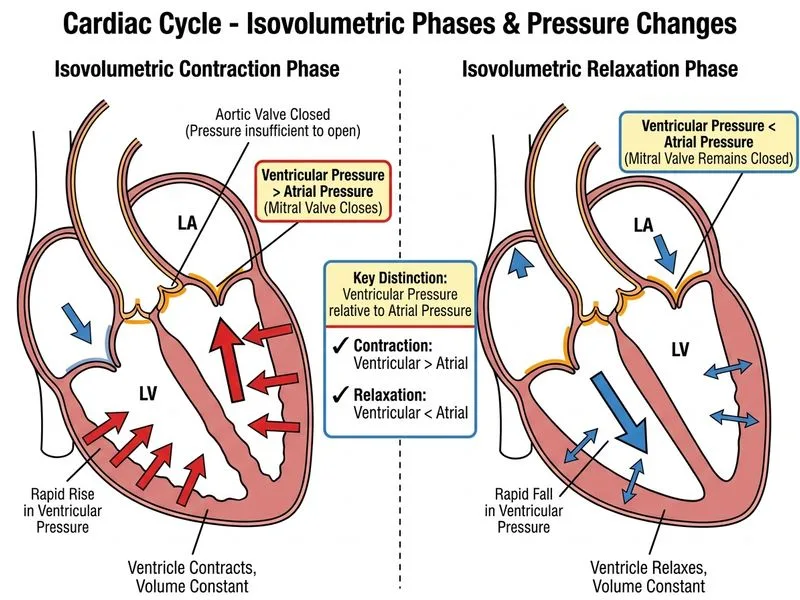
Which feature best distinguishes the isovolumetric contraction phase from the isovolumetric relaxation phase of the cardiac cycle?
A. The aortic valve remains closed throughout both phases
B. Both phases show no change in ventricular volume
C. Ventricular pressure exceeds atrial pressure during contraction but falls below atrial pressure during relaxation
D. Ventricular wall tension increases during contraction but decreases during relaxation
Explanation
Distinguishing Isovolumetric Contraction from Isovolumetric Relaxation
Phase Definitions
Both isovolumetric contraction and isovolumetric relaxation are periods during which ventricular volume remains constant because both the mitral/tricuspid and aortic/pulmonary valves are closed.
Key Discriminating Feature: Pressure Gradient Direction
Key Point
The critical difference lies in the direction of the pressure gradient between the ventricle and atrium.
Table
Feature
Isovolumetric Contraction
Isovolumetric Relaxation
Ventricular Pressure vs Atrial Pressure
VP > AP (rising)
VP < AP (falling)
Valve Status
Both AV and semilunar closed
Both AV and semilunar closed
Ventricular Volume
Constant
Constant
Wall Tension
Increasing
Decreasing
Duration
~0.05 seconds
~0.08 seconds
Atrial Filling
Atrium filling (AV closed)
Atrium filling (AV closed)
Mechanism
High-YieldNEET PG
During isovolumetric contraction, the ventricle develops pressure rapidly while all valves remain shut—ventricular pressure rises above atrial pressure, but the AV valve does not open because ventricular pressure has not yet exceeded aortic pressure. During isovolumetric relaxation, ventricular pressure falls below atrial pressure, which is why the AV valve opens at the end of this phase to allow ventricular filling.
Clinical Pearl
The pressure crossover point (where VP = AP) marks the transition from isovolumetric contraction to rapid ejection, and from isovolumetric relaxation to rapid filling. This is visible on a pressure-volume loop as the vertical portions.
Why This Matters
Mnemonic
"UP then DOWN" — In contraction, pressure goes UP (VP > AP); in relaxation, pressure goes DOWN (VP < AP). This pressure reversal is the defining discriminator.
Guyton & Hall Textbook of Medical Physiology Ch 9
Loading illustration…
Practice similar questions
Sign up free to access AI-powered MCQ practice with detailed explanations and adaptive learning.