Cardiac Cycle MCQ — NEET PG Practice Question | NEETPGAI
Cardiac Cycle
medium
heart-pulse Physiology
Which finding best distinguishes the rapid ventricular filling phase from the slow ventricular filling phase (diastasis) of the cardiac cycle?
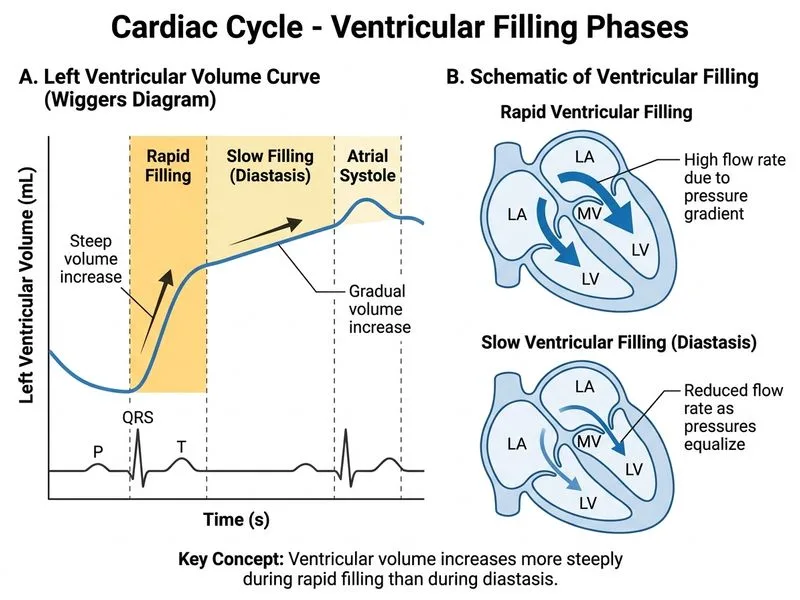
A. Ventricular volume increases more steeply during rapid filling than during diastasis
B. Atrial pressure is higher during rapid filling than during diastasis
C. The mitral valve is open during rapid filling but closed during diastasis
D. Atrial contraction contributes more to ventricular filling during diastasis than during rapid filling
Explanation
Distinguishing Rapid Ventricular Filling from Diastasis
Phase Overview
Ventricular diastole consists of three main filling phases:
1.
Isovolumetric relaxation — pressure drop, all valves closed
2.
Rapid ventricular filling — AV valve opens, steep inflow
3.
Diastasis (slow filling) — reduced inflow, atrium and ventricle equilibrate
4.
Atrial systole — active atrial contraction (sometimes considered separately)
The Discriminating Feature: Rate of Volume Change
Key Point
The slope of the ventricular volume curve is the defining difference. Rapid filling shows a steep positive slope (dV/dt is large); diastasis shows a much gentler slope (dV/dt is small).
Table
Feature
Rapid Filling
Diastasis
Ventricular Volume Change Rate
Steep (rapid)
Shallow (slow)
AV Valve Status
Open
Open
Atrial Pressure
Higher (driving gradient)
Lower (equilibrating)
Atrial Contribution to Filling
Passive (pressure gradient)
Active (atrial contraction)
Duration
~0.1 seconds
~0.2 seconds
Ventricular Pressure
Rising rapidly
Rising slowly
Pressure Gradient (AP – VP)
Large
Small
Mechanism
High-YieldNEET PG
Rapid ventricular filling occurs immediately after the mitral valve opens because there is a large pressure gradient between the atrium (which has been filling passively during ventricular systole) and the ventricle (which has just completed isovolumetric relaxation and has low pressure). Blood rushes in passively. As the ventricle fills and its pressure rises, the pressure gradient diminishes, inflow slows, and diastasis begins. During diastasis, the atrium and ventricle are nearly at the same pressure, and filling is minimal until atrial contraction occurs.
Clinical Pearl
On a ventricular volume curve, rapid filling produces the steepest slope. This is why the third heart sound (S3) occurs at the end of rapid filling—it represents the abrupt deceleration of inflow as the ventricle becomes less compliant. Diastasis is the flat, quiet part of diastole where little happens.
Mnemonic
"STEEP then FLAT" — Rapid filling = steep slope on volume curve; diastasis = flat slope.
Clinical Relevance
In restrictive cardiomyopathy or constrictive pericarditis, rapid filling is exaggerated (very steep) followed by abrupt halt (square root sign on pressure tracing), whereas in dilated cardiomyopathy, the slope is gentler throughout because the ventricle is already enlarged and compliant.
Guyton & Hall Textbook of Medical Physiology Ch 9
Loading illustration…
Practice similar questions
Sign up free to access AI-powered MCQ practice with detailed explanations and adaptive learning.