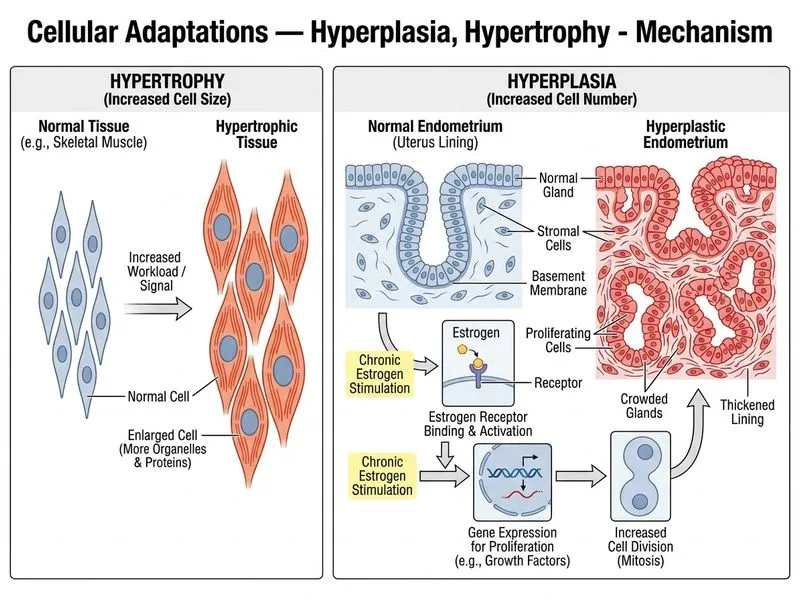
Endometrial hyperplasia in response to chronic estrogen stimulation represents which type of cellular adaptation?
A. Hyperplasia due to increased cell proliferation and increased cell number
B. Metaplasia due to replacement of one cell type with another
C. Hypertrophy due to increased protein synthesis in individual cells
D. Anaplasia due to loss of cellular differentiation
Explanation
Endometrial Hyperplasia: Hyperplasia as Adaptation
Key Point
Hyperplasia is an increase in the NUMBER of cells in an organ or tissue, resulting in increased tissue mass. It occurs through increased cell division (mitosis) in response to growth stimuli.
Mechanism of Endometrial Hyperplasia
Chronic estrogen stimulation (unopposed by progesterone) triggers:
1.
Estrogen receptor activation in endometrial epithelial cells
2.
Upregulation of growth factors — particularly insulin-like growth factor (IGF) and fibroblast growth factor (FGF)
Increased cell number — tissue mass increases due to more cells, not larger cells
Hyperplasia vs. Hypertrophy: Side-by-Side Comparison
Table
Parameter
Hyperplasia
Hypertrophy
Definition
↑ cell number
↑ cell size
Mechanism
Cell division (mitosis)
Protein synthesis
Reversibility
Fully reversible (remove stimulus)
Partially reversible
Organ mass
Increased
Increased
Individual cell size
Normal or small
Large
Example
Endometrial hyperplasia (estrogen)
Cardiac hypertrophy (HTN)
Pathological risk
Can progress to malignancy
Leads to dysfunction
High-YieldNEET PG
Endometrial hyperplasia is a REVERSIBLE adaptation — stopping estrogen stimulation (or adding progesterone) causes the excess cells to undergo apoptosis and tissue returns to normal.
Mnemonic
H-H Rule
Hyperplasia = How many (cell NUMBER)
Hypertrophy = How big (cell SIZE)
Clinical Pearl
Endometrial hyperplasia is a precancerous lesion (especially atypical hyperplasia) because continuous mitotic activity increases the risk of malignant transformation. This is why unopposed estrogen is a risk factor for endometrial cancer.
Loading illustration…
Practice similar questions
Sign up free to access AI-powered MCQ practice with detailed explanations and adaptive learning.