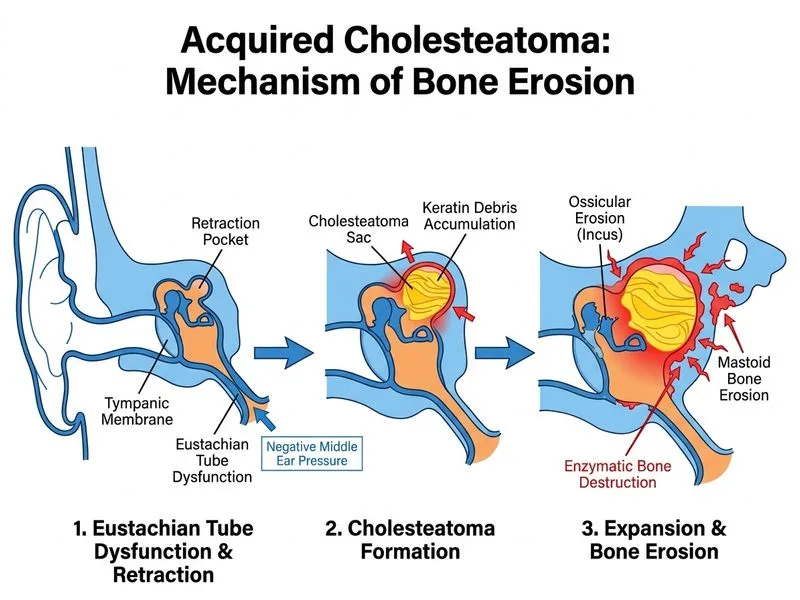
## Acquired Cholesteatoma vs. Chronic Suppurative Otitis Media (CSOM) ### Critical Distinction: Bone Erosion **Key Point:** The single most important distinguishing feature between acquired cholesteatoma and CSOM is **bone erosion**. Cholesteatoma is an **osteolytic disease** — the keratinous matrix and associated inflammation produce enzymes and cytokines that actively erode bone. Simple CSOM, even if chronic and purulent, does not typically cause significant bone destruction. ### Comparative Table | Feature | Acquired Cholesteatoma | CSOM (without Cholesteatoma) | | --- | --- | --- | | **Bone Erosion** | Present (hallmark finding) | Absent or minimal | | **Ossicular Erosion** | Common (stapes, incus) | Rare or absent | | **Epithelial Invasion** | Keratinized squamous epithelium invades middle ear | Mucosal inflammation only | | **Otorrhea Character** | Foul-smelling, purulent | Purulent but may be less offensive | | **Posterosuperior Defect** | Typical location | Can occur in any quadrant | | **Imaging Hallmark** | Bone erosion, ossicular damage | Fluid/pus, no bone destruction | | **Surgical Management** | Canal wall down (CWD) or CWU | Medical management ± myringoplasty | ### High-Yield Point **High-Yield:** Bone erosion on HRCT is the **radiologic gold standard** for diagnosing cholesteatoma. Look for: - Erosion of the scutum - Erosion of the lateral semicircular canal (LSCC) - Ossicular erosion (especially long process of incus, stapes superstructure) - Erosion of the posterior canal wall ### Clinical Pearl **Clinical Pearl:** A patient with CSOM may have a posterosuperior perforation and foul otorrhea, but if imaging shows NO bone erosion, it is NOT cholesteatoma — it is marginal or attic perforation with secondary infection. Bone destruction is the pathologic hallmark of cholesteatoma. ### Pathophysiology Cholesteatoma produces bone-resorbing cytokines (IL-1, TNF-α, RANKL) and proteolytic enzymes that activate osteoclasts. This osteolytic process is absent in simple CSOM, where inflammation is mucosal but does not invade and erode bone. ### Mnemonic **Mnemonic:** **CHOL = Bone Hole** (Cholesteatoma = bone erosion/hole). CSOM = pus, not bone loss. 
Sign up free to access AI-powered MCQ practice with detailed explanations and adaptive learning.