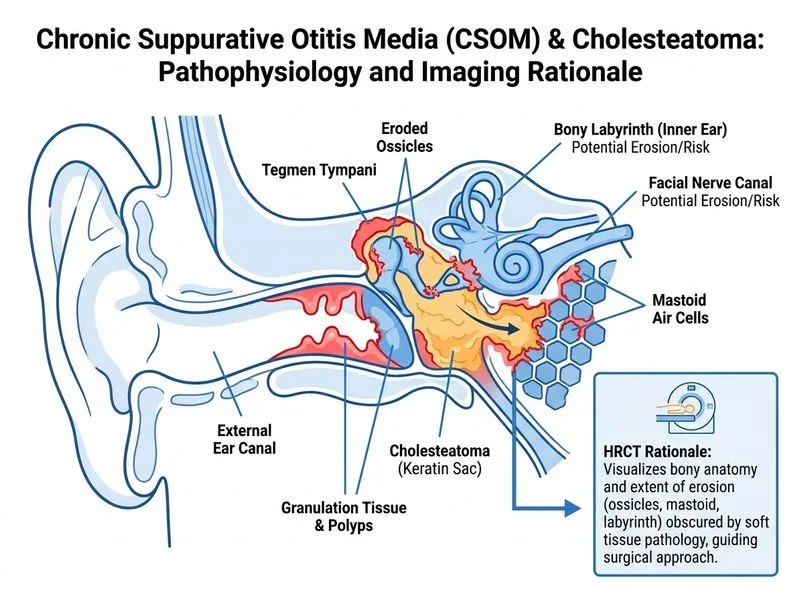
## Investigation of Choice in CSOM with Suspected Bone Erosion **Key Point:** HRCT temporal bone is the gold standard imaging modality for assessing ossicular erosion, mastoid pneumatization, and bony erosion in chronic suppurative otitis media (CSOM), especially when surgical intervention is being considered. ### Why HRCT is Superior **High-Yield:** HRCT provides: - Excellent bony detail with sub-millimeter resolution - Clear visualization of ossicular chain integrity (malleus, incus, stapes) - Assessment of mastoid pneumatization and sclerosis - Detection of tegmental dehiscence or sinus plate erosion - Evaluation of facial nerve canal integrity - Identification of cholesteatoma (if present) with high sensitivity **Clinical Pearl:** In this patient with 10 years of active discharge, granulation tissue, and polyps, there is high risk of ossicular erosion and possible mastoid bone involvement. HRCT guides the surgeon on the extent of disease and helps plan the surgical approach (canal wall-up vs. canal wall-down mastoidectomy). ### Comparison with Other Modalities | Investigation | Role in CSOM | Limitation | |---|---|---| | **HRCT temporal bone** | **Gold standard for bone erosion, ossicular status** | **Cannot assess soft tissue detail as well as MRI** | | MRI brain/IAC | Soft tissue detail, intracranial complications | Poor bone resolution; not first-line for ossicular assessment | | Pure tone audiometry | Quantifies hearing loss; documents conductive component | Functional test only; does not show anatomical erosion | | Otoacoustic emissions | Cochlear function assessment | No role in assessing middle ear bone disease | **Mnemonic:** **HRCT-CSOM** = **H**igh-**R**esolution **C**T for **T**emporal bone in **C**hronic **S**uppurative **O**titis **M**edia ### Clinical Context Given the presence of: - Long-standing disease (10 years) - Active granulation and polyps (suggest aggressive disease) - Planned surgical intervention (likely needed) ...HRCT is essential to: 1. Confirm ossicular erosion (especially incus long process) 2. Assess mastoid pneumatization 3. Rule out tegmental or sinus plate erosion 4. Plan surgical approach and extent of mastoidectomy 
Sign up free to access AI-powered MCQ practice with detailed explanations and adaptive learning.