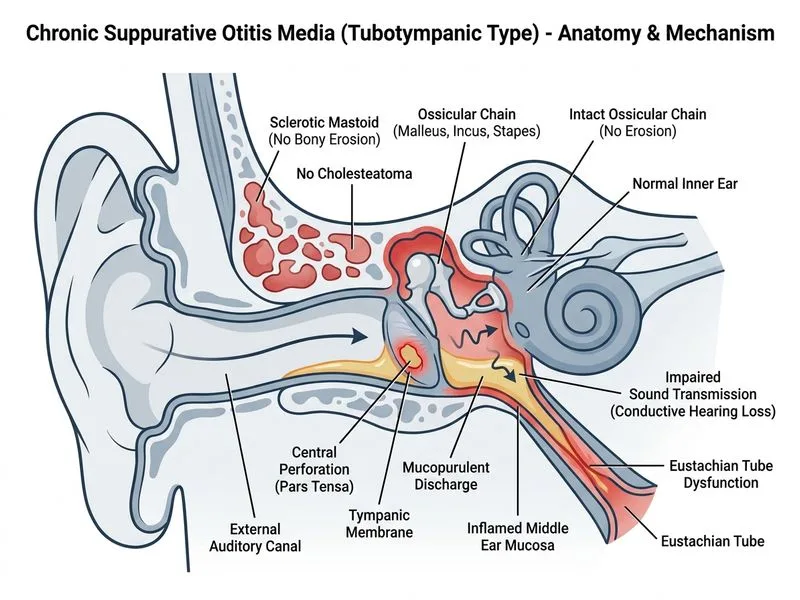
## Management Strategy for Chronic Suppurative Otitis Media (CSOM) — Safe Type ### Clinical Context This patient has **safe CSOM** (central perforation, no ossicular erosion, no cholesteatoma on imaging). The air-bone gap of 35 dB indicates conductive hearing loss from ossicular involvement or perforation itself. ### Stepwise Management Algorithm ```mermaid flowchart TD A[CSOM diagnosis confirmed]:::outcome --> B{Cholesteatoma or ossicular erosion?}:::decision B -->|Yes| C[Surgical intervention: Ossiculoplasty ± Mastoidectomy]:::action B -->|No| D[Conservative management first]:::action D --> E[Aural toilet + topical antibiotics]:::action E --> F[Hearing assessment + trial of hearing aid if needed]:::action F --> G[Review at 3 months]:::decision G -->|Persistent discharge| H[Consider tympanoplasty]:::action G -->|Dry ear, acceptable hearing| I[Continue conservative care]:::outcome ``` ### Rationale for Conservative Management **Key Point:** In safe CSOM without ossicular erosion or cholesteatoma, the goal is to achieve a **dry ear** before considering ossiculoplasty. Ossiculoplasty is contraindicated in an actively draining ear because of poor graft take and infection risk. **High-Yield:** The sequence is: **Aural toilet → Topical antibiotics → Hearing aid trial → Reassess → Then ossiculoplasty only if ear remains dry and patient desires hearing improvement.** ### Components of Conservative Management | Step | Rationale | |------|----------| | **Aural toilet** | Remove discharge, debris; allows topical agents to penetrate | | **Topical antibiotics** (e.g., ciprofloxacin drops) | Fluoroquinolones are safe in perforated ears; reduce bacterial load | | **Avoid water entry** | Prevent superinfection; advise cotton + vaseline during bathing | | **Hearing aid trial** | Assess functional benefit before committing to surgery | | **3-month reassessment** | Determine if ear has dried; if so, ossiculoplasty becomes an option | **Clinical Pearl:** Ossiculoplasty in an actively draining ear has graft failure rates >50%. Always achieve a dry ear first. ### When to Escalate to Surgery - Persistent discharge despite 3 months of conservative care - Recurrent acute exacerbations - Patient desire for hearing improvement *and* dry ear achieved - Evidence of ossicular erosion on repeat imaging [cite:Scott-Brown's Otorhinolaryngology Ch 68] 
Sign up free to access AI-powered MCQ practice with detailed explanations and adaptive learning.