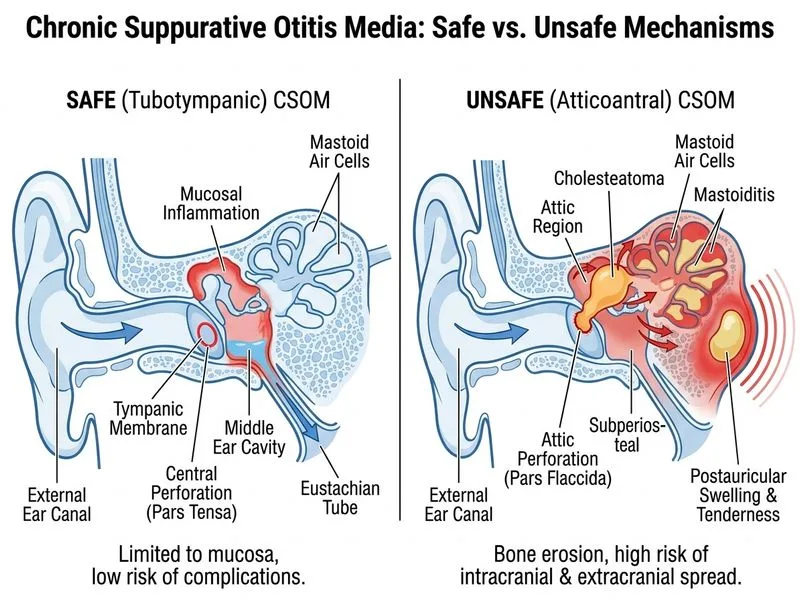
## Distinguishing Safe vs Unsafe CSOM ### Overview Chronic suppurative otitis media is classified into two types based on location of perforation and risk of serious complications: - **Safe (Tubotympanic)**: perforation in pars tensa, lower risk - **Unsafe (Atticoantral)**: perforation in pars flaccida or marginal, high risk of bone erosion and intracranial complications ### Key Discriminating Feature: Bone Erosion & Complications **Key Point:** Postauricular swelling, tenderness, and subperiosteal abscess formation are hallmark signs of unsafe CSOM because the disease erodes the mastoid cortex and can lead to mastoiditis with pus tracking beneath the periosteum. ### Comparison Table | Feature | Safe (Tubotympanic) | Unsafe (Atticoantral) | |---------|-------------------|----------------------| | **Perforation site** | Pars tensa (central) | Pars flaccida or marginal | | **Bone erosion** | Absent or minimal | Marked; erodes ossicles, mastoid cortex | | **Postauricular signs** | Absent | Swelling, tenderness, subperiosteal abscess | | **Discharge character** | Mucopurulent, non-foul | Foul-smelling, purulent | | **Complications** | Rare | Common (meningitis, brain abscess, sigmoid sinus thrombosis) | | **Ossicular involvement** | Stapes usually spared | Malleus and incus eroded | **High-Yield:** Postauricular swelling and subperiosteal abscess are pathognomonic for unsafe CSOM with active mastoid bone disease — this is the single most important clinical discriminator because it reflects the aggressive, bone-eroding nature of atticoantral disease. ### Clinical Pearl A patient with CSOM who develops postauricular tenderness, swelling, or fluctuance requires urgent imaging (CT mastoid) and often surgical intervention (cortical mastoidectomy) to prevent life-threatening intracranial spread. ### Why Other Features Are Non-Discriminatory - **Foul-smelling discharge**: While more common in unsafe CSOM, it can occur in both types and is not pathognomonic - **Conductive hearing loss**: Present in both safe and unsafe CSOM due to ossicular involvement - **Duration > 6 weeks**: Defines chronicity in both types; not a discriminator 
Sign up free to access AI-powered MCQ practice with detailed explanations and adaptive learning.