Complications of Fractures MCQ — NEET PG Practice Question | NEETPGAI
Complications of Fractures
medium
bone Orthopedics
A 32-year-old male presents to the emergency department 6 hours after a motor vehicle accident with a closed fracture of the right femur. On examination, the limb is swollen and tense. Compartment pressure measured at the anterior compartment is 65 mmHg (diastolic blood pressure = 80 mmHg). The patient reports severe pain out of proportion to the clinical findings and pain with passive dorsiflexion of the foot. What is the most appropriate next step in management?
A. Perform emergency fasciotomy of the affected compartment
B. Elevate the limb above the heart and apply ice packs
C. Administer high-dose intravenous corticosteroids
D. Apply skeletal traction and observe for 24 hours
Explanation
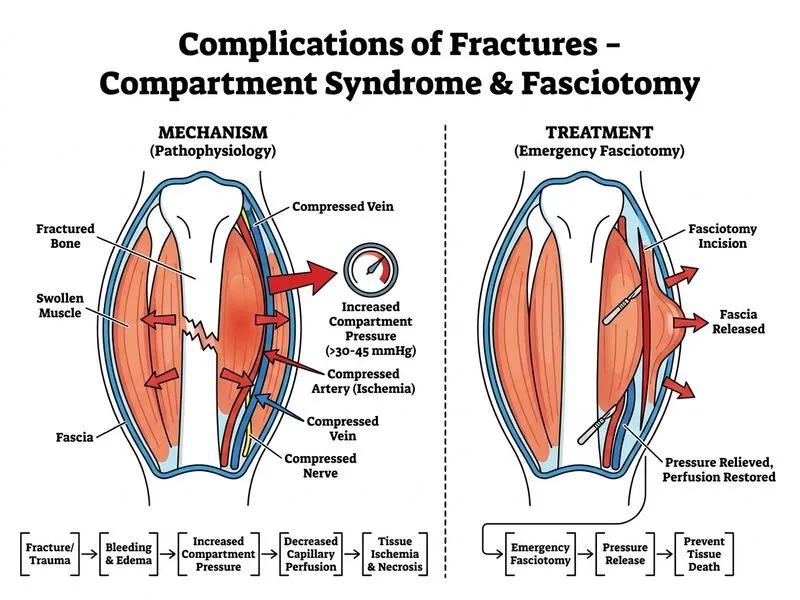
Acute Compartment Syndrome (ACS) — Recognition and Management
Clinical Presentation
This patient demonstrates the classic triad of acute compartment syndrome (ACS):
Severe pain out of proportion to the clinical injury
Pain with passive stretch of muscles in the affected compartment (passive dorsiflexion = anterior compartment pain)
Tense, swollen compartment with elevated pressure
Compartment Pressure Interpretation
Key Point
The diagnosis of ACS is based on the pressure gradient, not absolute pressure alone.
Pressure Gradient=Compartment Pressure−Diastolic BP
In this case:
Compartment pressure = 65 mmHg
Diastolic BP = 80 mmHg
Gradient = 65 − 80 = −15 mmHg (or effectively, compartment pressure within 30 mmHg of diastolic BP)
High-YieldNEET PG
A compartment pressure ≥30 mmHg below diastolic BP (or ≥45 mmHg absolute in hypotensive patients) is diagnostic of ACS and warrants immediate fasciotomy.
Fasciotomy Indications
Table
Finding
Action
Clinical signs + high pressure
Fasciotomy without delay
Equivocal signs + borderline pressure
Measure pressure serially; fasciotomy if trend worsens
Pressure gradient ≥30 mmHg below DBP
Emergency fasciotomy
Pain with passive stretch
Strong clinical indicator for fasciotomy
Clinical Pearl
ACS is a surgical emergency. Delay >6–8 hours from onset leads to irreversible muscle necrosis, contracture, and permanent disability. The "6-hour rule" is a rough guideline, but clinical judgment (pain, pressure gradient) takes precedence.
Why Fasciotomy Now?
1.
Pressure gradient is in the critical range (≥30 mmHg below DBP)
2.
Clinical signs are unequivocal (pain on passive stretch, severe pain out of proportion)
3.
Time-sensitive: Muscle ischemia becomes irreversible after 6–8 hours
4.
Two-incision fasciotomy of anterior and lateral compartments is standard for femoral fracture ACS
Mnemonic: "5 P's" of ACS — Pain (out of proportion), Pressure (elevated compartment), Pain with passive stretch, Pallor, Pulselessness (late sign). The first three are present here.
Post-Fasciotomy Management
Leave wound open; plan delayed closure or skin grafting in 3–5 days
Manage fracture separately (ORIF vs. external fixation)
Monitor for rhabdomyolysis complications (hyperkalemia, acute kidney injury)
Loading illustration…
Practice similar questions
Sign up free to access AI-powered MCQ practice with detailed explanations and adaptive learning.