Complications of Fractures MCQ — NEET PG Practice Question | NEETPGAI
Complications of Fractures
medium
bone Orthopedics
A 28-year-old woman with a closed fracture of the tibia sustained 3 weeks ago now presents with fever, localized swelling, and purulent drainage from the fracture site. Plain radiographs show early periosteal new bone formation. Which investigation is most appropriate to confirm osteomyelitis and guide antibiotic therapy?
A. Blood culture
B. CT scan of the tibia
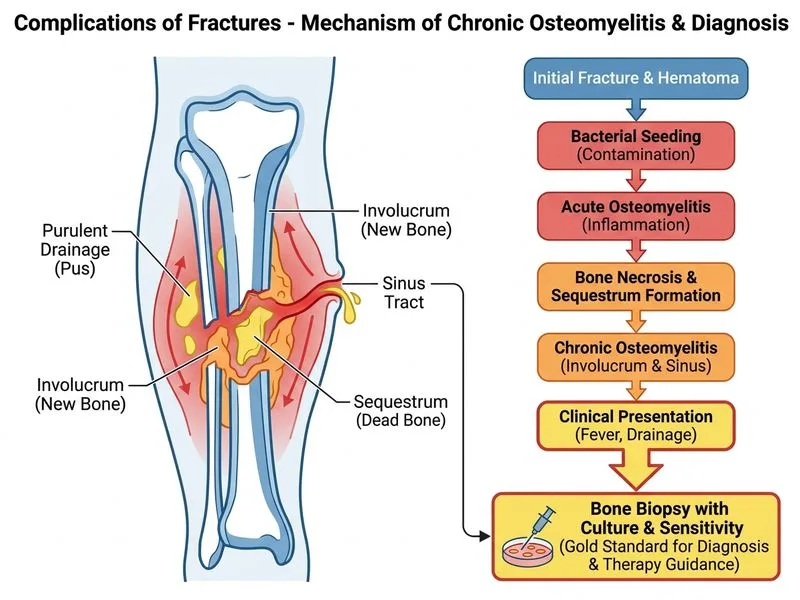
C. Bone biopsy with culture and sensitivity
D. Technetium-99m bone scan
Explanation
Diagnosis of Post-Traumatic Osteomyelitis
Key Point
Post-traumatic osteomyelitis requires microbiological confirmation (culture and sensitivity) from bone tissue to guide targeted antibiotic therapy. Blood cultures are low-yield in chronic osteomyelitis.
Why Bone Biopsy is Gold Standard
Osteomyelitis complicating a fracture (especially after 2–3 weeks) is a bone infection requiring:
1.
Microbiological diagnosis — culture of bone tissue to identify causative organism
2.
Sensitivity testing — to guide appropriate antibiotic selection
3.
Histopathology — to confirm inflammation and rule out other diagnoses (malignancy, necrosis)
High-YieldNEET PG
Bone biopsy (via open surgical approach or percutaneous needle biopsy under image guidance) is the gold standard for diagnosing osteomyelitis and obtaining material for culture and sensitivity.
Comparison of Investigations
Table
Investigation
Sensitivity
Specificity
Role
Bone biopsy + culture
90–95%
95–100%
Gold standard; guides therapy
Blood culture
30–50% in chronic OM
High
Low yield in post-traumatic OM
Tc-99m bone scan
High (80–90%)
Low (50–60%)
Detects osteomyelitis but not specific; cannot guide antibiotics
CT scan
Detects bone destruction
Not specific
Shows anatomical changes; does not identify organism
Clinical Pearl
In post-traumatic osteomyelitis, blood cultures are often negative because infection is localized to bone. Bone tissue culture is essential.
Warning
Do NOT rely on blood culture alone in chronic or post-traumatic osteomyelitis — it will delay diagnosis and appropriate therapy. Bone biopsy is mandatory.
Mnemonic
BIOPSY for OMY — Bone biopsy is the gold standard for Osteomyelitis diagnosis, yielding organism identification and sensitivity data.
Loading illustration…
Practice similar questions
Sign up free to access AI-powered MCQ practice with detailed explanations and adaptive learning.