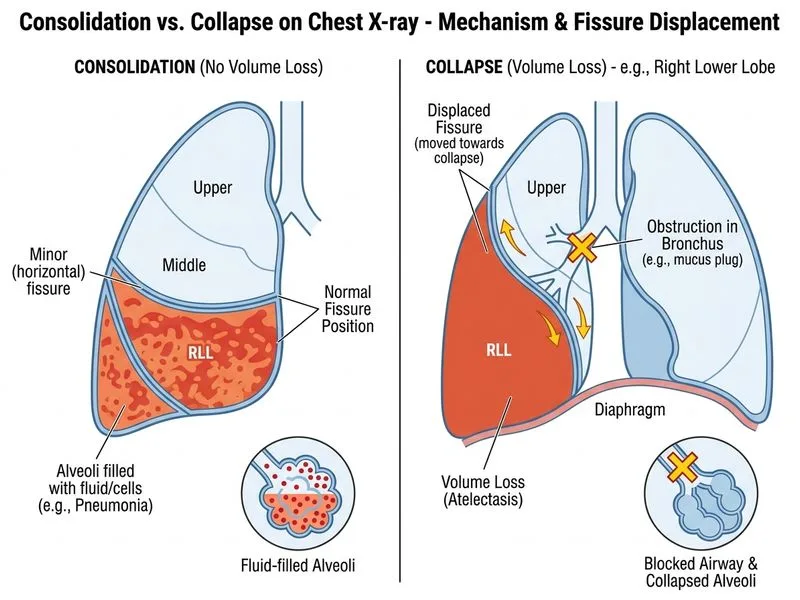
On a frontal chest X-ray, the right lower lobe fissure is displaced superiorly and medially. What is the most likely diagnosis?
A. Right pleural effusion
B. Right lower lobe collapse
C. Right lower lobe cavitation
D. Right lower lobe consolidation
Explanation
Fissural Displacement and Lobe Collapse
Key Point
Superior and medial displacement of a fissure indicates volume loss in the lobe bounded by that fissure. The right lower lobe is bounded by the oblique (major) fissure; its upward shift means the lower lobe has shrunk (collapsed).
Anatomy of Fissural Displacement
Loading diagram...
High-YieldNEET PG
Fissural displacement ALWAYS indicates volume change. Superior displacement = loss of volume = collapse. Inferior displacement = gain of volume = consolidation or effusion.
Collapse Patterns by Lobe
Table
Lobe
Fissure Displaced
Direction
Associated Signs
Right upper
Horizontal fissure
Superiorly
Elevated hilum, mediastinal shift
Right middle
Horizontal + oblique
Medially
Silhouette of right heart border
Right lower
Oblique fissure
Superiorly & medially
Silhouette of right hemidiaphragm
Left upper
Oblique fissure
Superiorly & anteriorly
Elevated left hilum
Left lower
Oblique fissure
Posteriorly & superiorly
Silhouette of left hemidiaphragm
Clinical Pearl
When you see fissural displacement, always ask: "Is the fissure moving TOWARD or AWAY FROM the hilum?" Toward = collapse. Away = consolidation or effusion.