
After lung resection, opacities can represent:
| Feature | CT Advantage |
|---|---|
| Tissue characterization | Distinguishes consolidation (homogeneous, air bronchograms) from atelectasis (wedge-shaped, no air bronchograms) |
| Contrast enhancement | Consolidation enhances; atelectasis does not (or minimally) |
| Vascular involvement | Detects pulmonary embolism (post-op risk) |
| Pleural/mediastinal assessment | Evaluates for effusion, hematoma, or mediastinal shift |
| Exclusion of complications | Pneumonia, abscess, bronchopleural fistula |
Lateral decubitus X-ray: Useful only for detecting free pleural fluid; does not characterize parenchymal consolidation or atelectasis in the post-operative setting.
Bronchoscopy with BAL: Invasive and non-specific; used therapeutically (to clear secretions in atelectasis) or diagnostically (to obtain cultures), but does not definitively characterize the opacity on imaging.
Ventilation-perfusion scan: Outdated for this purpose; CT pulmonary angiography (CTPA) has replaced V/Q scanning for PE detection, and CT chest is superior for parenchymal characterization.
Mnemonic: CT for Post-op Opacity — Characterization, Tissue assessment, Exclusion of PE and complications.
Loading illustration…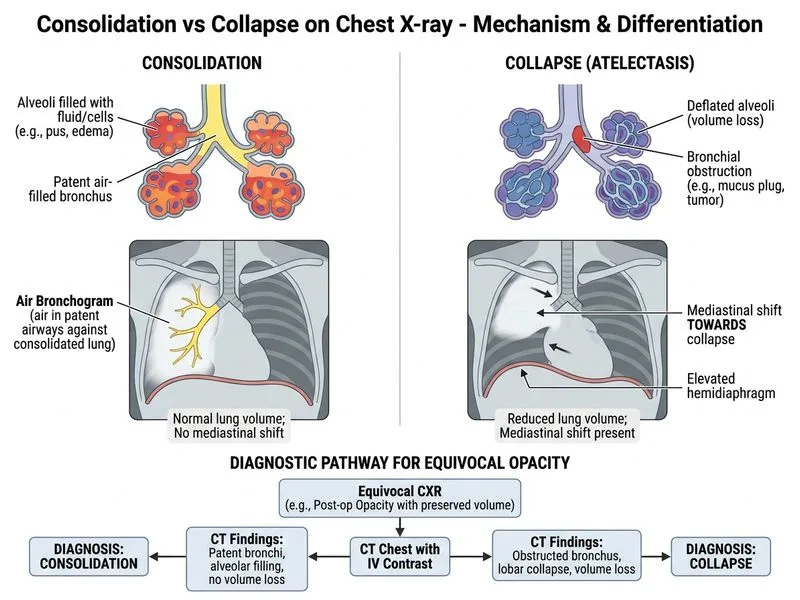
Sign up free to access AI-powered MCQ practice with detailed explanations and adaptive learning.
Daily MCQs, study tips, and topper strategies on Telegram.
Join on Telegram →