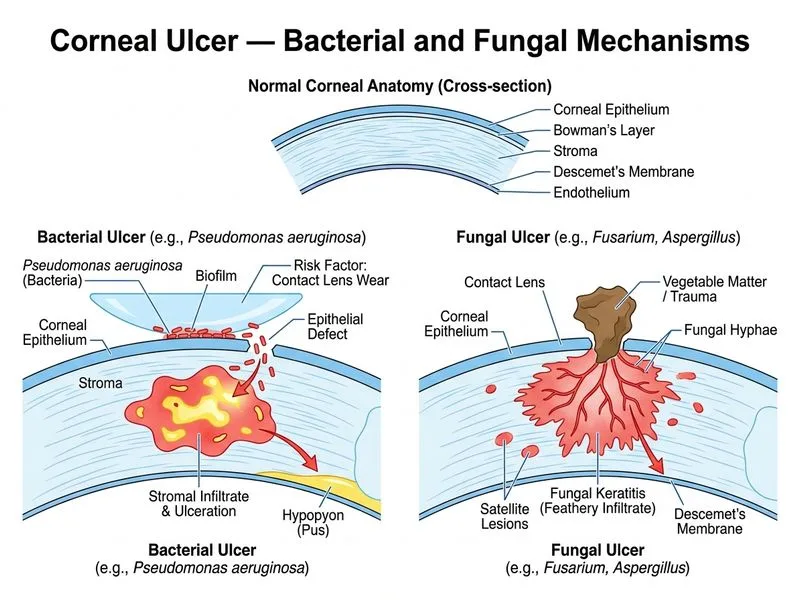
## Pseudomonas aeruginosa in Contact Lens-Related Corneal Ulcers **Key Point:** Pseudomonas aeruginosa is the most common cause of contact lens-associated bacterial corneal ulcers, accounting for 40–50% of cases in this population. ### Why Pseudomonas Dominates in Contact Lens Wearers 1. **Biofilm formation** — Pseudomonas readily colonizes contact lens surfaces and cases, forming biofilms resistant to antimicrobial agents. 2. **Hypoxia-induced adhesion** — Contact lenses reduce corneal oxygen availability, promoting Pseudomonas adhesion to the epithelium. 3. **Virulence factors** — Produces exotoxin A, elastase, and alkaline protease, causing rapid stromal invasion and melting. 4. **Environmental reservoir** — Thrives in lens solution, tap water, and non-sterile lens care. ### Clinical Features of Pseudomonas Corneal Ulcer | Feature | Characteristic | | --- | --- | | **Onset** | Rapid (24–48 hours) | | **Infiltrate** | Dense, central, with stromal involvement | | **Hypopyon** | Common and prominent | | **Progression** | Aggressive; risk of perforation if untreated | | **Exudate** | Mucopurulent, often greenish | **High-Yield:** Pseudomonas produces a characteristic **blue-green pigment** (pyoverdine) visible under slit lamp, though not always present in early disease. ### Antibiotic Coverage **Clinical Pearl:** Topical fluoroquinolones (ciprofloxacin, ofloxacin, moxifloxacin) are first-line for suspected Pseudomonas corneal ulcers. Fourth-generation fluoroquinolones (moxifloxacin) have superior gram-positive coverage and are preferred if Staphylococcus cannot be excluded. **Warning:** Aminoglycosides (gentamicin, tobramycin) are effective but carry risk of epithelial toxicity with prolonged use; reserve for severe cases or combination therapy. ### Differential Organisms in Non-Contact Lens Ulcers - **Staphylococcus aureus** — Most common in non-contact lens bacterial ulcers; slower onset, less aggressive. - **Streptococcus pneumoniae** — Associated with trauma, ocular surface disease; rare in contact lens wearers. - **Moraxella catarrhalis** — Uncommon cause; typically in immunocompromised hosts. 
Sign up free to access AI-powered MCQ practice with detailed explanations and adaptive learning.