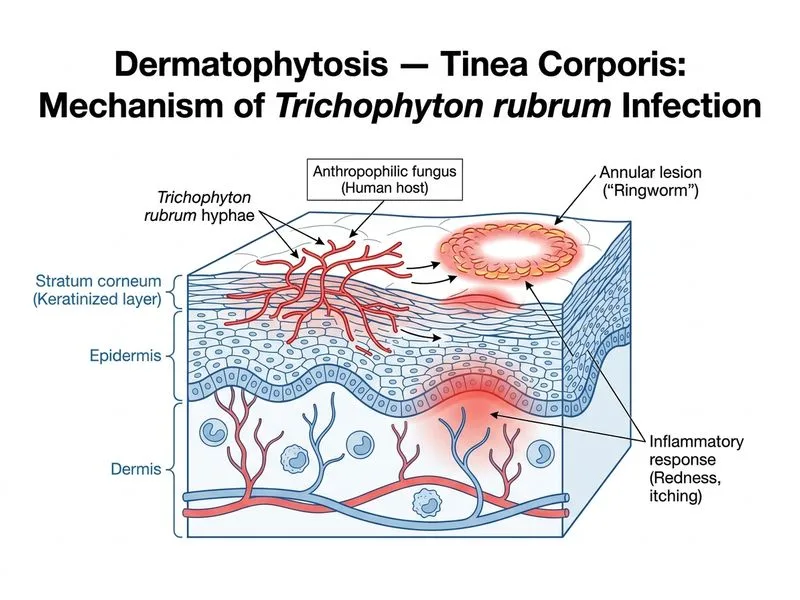
Which of the following dermatophytes is anthropophilic and most commonly causes tinea corporis in humans?
A. Trichophyton verrucosum
B. Trichophyton rubrum
C. Trichophyton mentagrophytes var. quinckeanum
D. Microsporum canis
Explanation
Anthropophilic Dermatophytes
Key Point
Anthropophilic dermatophytes have adapted to human skin and are the most common cause of dermatophytosis worldwide. They cause chronic infections with minimal inflammation.
High-YieldNEET PG
Trichophyton rubrum is the single most common dermatophyte globally, responsible for approximately 70% of all dermatophyte infections, particularly tinea corporis, tinea pedis, and tinea unguium.
Classification of Dermatophytes by Host Preference
Table
Category
Characteristics
Examples
Clinical Pattern
Anthropophilic
Adapted to humans; chronic, minimally inflammatory
T. rubrum, T. mentagrophytes var. mentagrophytes, E. floccosum
Chronic, indolent
Zoophilic
Animal-adapted; acute, highly inflammatory when infect humans
M. canis, T. mentagrophytes var. quinckeanum, T. verrucosum
Acute, severe inflammation
Geophilic
Soil-dwelling; rare in humans; acute inflammation
T. mentagrophytes var. mentagrophytes (some strains), M. gypseum
Occupational exposure
Clinical Pearl
Anthropophilic species cause chronic infections because they have evolved to evade human immune responses. Zoophilic infections are typically more acute and inflammatory because the organism is not adapted to human skin.
Mnemonic — Common Anthropophilic Dermatophytes: "REM"
R — Rubrum (T. rubrum)
E — Erinacei (T. erinacei)
M — Mentagrophytes var. mentagrophytes (T. mentagrophytes var. mentagrophytes)
Why T. rubrum Dominates
1.
Highly adapted to human keratinous tissues
2.
Produces keratinolytic enzymes optimized for human skin pH and temperature