NEETPGAI
FeaturesNEET PGFMGEINI-CETBlogPricing
Log inStart Free
NEETPGAI

AI-powered NEET PG preparation platform. Master all 19 subjects with adaptive MCQs, AI tutoring, and spaced repetition.

Product

  • Features
  • Subjects
  • Previous Year Questions
  • NEET PG Preparation
  • FMGE Preparation
  • INI-CET Preparation
  • Compare
  • Pricing
  • Blog

Features

  • Adaptive MCQ Practice
  • AI Tutor
  • Mock Tests
  • Spaced Repetition

Resources

  • Blog
  • Study Guides
  • NEET PG Updates
  • Contact & support

Legal

  • Privacy Policy
  • Terms of Service

Stay updated

© 2026 NEETPGAI. All rights reserved.
    Subjects/Dermatology/Dermatophytosis — Tinea
    Dermatophytosis — Tinea
    medium
    hand Dermatology

    A 32-year-old woman presents with a 6-week history of pruritic, scaly patches on both groins and inner thighs. Examination reveals well-demarcated erythematous plaques with a raised, advancing border and central clearing. KOH mount of scale shows branching septate hyphae. She has already used topical antifungals (clotrimazole) for 3 weeks without improvement. What is the most appropriate next step in management?

    A. Continue topical clotrimazole for another 4 weeks
    B. Start oral terbinafine 250 mg daily for 2–4 weeks
    C. Perform fungal culture and await results before further treatment
    D. Switch to topical miconazole and add oral fluconazole

    Explanation

    Clinical Context

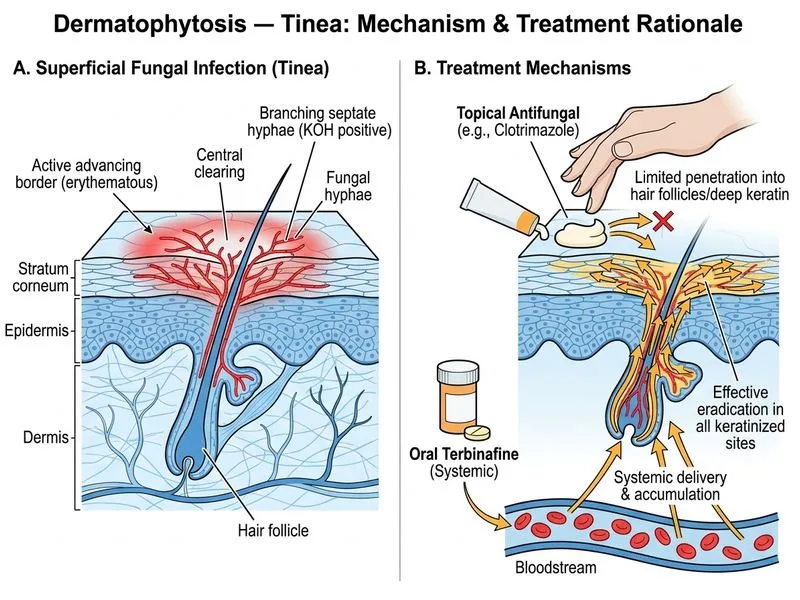
    This patient has tinea cruris (jock itch) confirmed by:

    • Clinical morphology: well-demarcated erythematous plaques with raised border and central clearing

    • KOH positivity: branching septate hyphae (dermatophyte)
    • Failure of topical therapy after 3 weeks — the key trigger for systemic treatment

    Why Oral Terbinafine Is the Next Step

    Key Point
    Tinea of intertriginous areas (groin, axillae, inframammary folds) that fails topical therapy for ≥2–3 weeks requires systemic antifungal therapy.
    High-YieldNEET PG
    Terbinafine is the first-line oral agent for dermatophyte infections because:
    1. 1.
      Fungicidal (not fungistatic) — kills the organism
    2. 2.
      Shorter duration: 2–4 weeks for tinea corporis/cruris (vs. 4–6 weeks for azoles)
    3. 3.
      Better efficacy in warm, moist areas where topical penetration is poor
    4. 4.
      Oral bioavailability is excellent; achieves high concentrations in skin and nails
    Clinical Pearl
    Intertriginous tinea is notoriously prone to treatment failure with topicals alone because:
    • Moisture and maceration impair drug penetration
    • Occlusion favours fungal growth
    • Compliance is often suboptimal in skinfolds

    Dosing & Duration

    Table
    AgentDoseDuration (Tinea Cruris)Notes
    Terbinafine250 mg daily2–4 weeksFungicidal; first-line
    Fluconazole150 mg weekly4–6 weeksFungistatic; slower
    Itraconazole200 mg daily4 weeksFungistatic; less preferred

    Management Algorithm

    Loading diagram...
    Mnemonic
    TERBINAFINE for TINEA — Terbinafine is The Top choice for Topical-Resistant dermatophyte infections.

    Loading illustration…Dermatophytosis — Tinea diagram

    Practice similar questions

    Sign up free to access AI-powered MCQ practice with detailed explanations and adaptive learning.

    Start Practicing Free More Dermatology Questions

    Join our NEET PG community

    Daily MCQs, study tips, and topper strategies on Telegram.

    Join on Telegram →