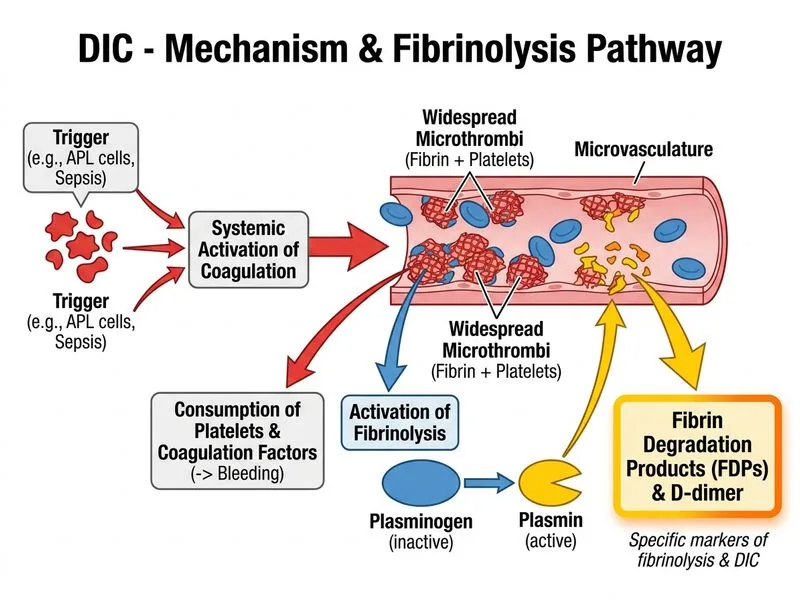
## Diagnosis of DIC: Most Specific Investigation **Key Point:** While multiple coagulation parameters are deranged in DIC, **D-dimer** is considered the most specific marker for confirming DIC because it reflects both active thrombin generation (fibrin formation) AND subsequent fibrinolysis — the dual pathological hallmark of DIC. ### Why D-dimer is the Most Specific Marker for DIC **High-Yield:** D-dimer is a specific fibrin degradation product generated when cross-linked fibrin (formed by thrombin activation) is cleaved by plasmin. This makes it a direct indicator of *both* coagulation activation and fibrinolysis occurring simultaneously — the defining feature of DIC. | Investigation | Specificity for DIC | What It Measures | |---|---|---| | **D-dimer** | **Highest** | Cross-linked fibrin degradation; reflects both thrombin & plasmin activity | | FDP | High but less specific | Fibrin AND fibrinogen degradation products (less specific — also elevated with fibrinogenolysis alone) | | Platelet count | Low | Consumption (non-specific; many causes) | | PT/aPTT | Low | Coagulation factor consumption (non-specific) | | Fibrinogen | Low | Consumption (non-specific) | ### D-dimer vs. FDP: The Critical Distinction **Clinical Pearl:** FDP measures degradation products of *both* fibrin and fibrinogen, so it can be elevated in conditions with primary fibrinogenolysis (e.g., liver disease, thrombolytic therapy) without true DIC. D-dimer, by contrast, is generated *only* from cross-linked fibrin — meaning it requires prior thrombin-mediated fibrin clot formation. This makes D-dimer more specific for the intravascular coagulation component of DIC. Per the **ISTH scoring system for overt DIC**, D-dimer/FDP elevation is a key criterion, but D-dimer is the preferred marker in modern practice due to its superior specificity for cross-linked fibrin breakdown. ### ISTH Scoring System for Overt DIC The International Society on Thrombosis and Haemostasis (ISTH) uses a composite score incorporating: 1. Platelet count (↓) 2. **D-dimer** (↑↑) — preferred fibrin marker 3. PT prolongation (↑) 4. Fibrinogen (↓) ### Why APL is a Classic DIC Trigger **Mnemonic: STOP-DIC** — Sepsis, Trauma, Obstetric complications, Pancreatitis, Disseminated malignancy (especially APL), Intravascular hemolysis, Cardiopulmonary bypass. APL (t(15;17)) releases tissue factor and cancer procoagulants from abnormal promyelocytes, making it the **highest-risk hematologic malignancy for DIC**. This patient's findings (thrombocytopenia, prolonged PT/aPTT, low fibrinogen) are classic for DIC in APL. ### Clinical Application **Tip:** In a patient with suspected DIC: - Order **D-dimer** for confirmation (most specific for cross-linked fibrin breakdown) - Use FDP as a complementary test (sensitive but less specific) - Combine with platelet count, fibrinogen, and PT/aPTT for ISTH scoring - Serial D-dimer monitoring tracks DIC progression and response to treatment [cite: Harrison's Principles of Internal Medicine 21e; Robbins & Cotran Pathologic Basis of Disease 10e Ch 12; ISTH DIC Scoring Guidelines]
Sign up free to access AI-powered MCQ practice with detailed explanations and adaptive learning.