
| Feature | APL-DIC | Sepsis-DIC |
|---|---|---|
| Primary driver | TF + Cancer Procoagulant + Annexin II (fibrinolysis) | Endotoxin → monocyte/endothelial TF expression |
| Fibrinolysis | ↑↑↑ (hyperfibrinolytic) | Variable (often suppressed by PAI-1) |
| Fibrinogen | ↓↓↓ (severely low, often <100 mg/dL) | ↓↓ (moderate reduction) |
| D-dimer / FDP | ↑↑↑ (markedly elevated) | ↑↑ (elevated, but less extreme) |
| Platelets | ↓↓↓ | ↓↓↓ |
| PT / aPTT | Prolonged | Prolonged |
| Factor V | Consumed (not reliably spared) | Consumed |
This combination of intense fibrin generation AND accelerated fibrinolysis produces profoundly low fibrinogen (often <50–100 mg/dL) and extremely high D-dimer/FDP — a degree of hypofibrinogenemia that is characteristically more severe than in typical sepsis-DIC, where PAI-1 elevation often suppresses fibrinolysis.
Why Option B is incorrect: While APL cells do express elevated TF and cancer procoagulant, the claim that Factor V is "normal or mildly reduced" in APL-DIC is not supported by standard references (Williams Hematology, Harrison's). Factor V is consumed in both APL-DIC and sepsis-DIC; Factor V preservation is not a reliable distinguishing feature in clinical practice.
Reference: Levi M, Scully M. How I treat disseminated intravascular coagulation. Blood. 2018; Tallman MS, Altman JK. How I treat acute promyelocytic leukemia. Blood. 2009; Harrison's Principles of Internal Medicine, 21st ed., Chapter on Coagulation Disorders.
Loading illustration…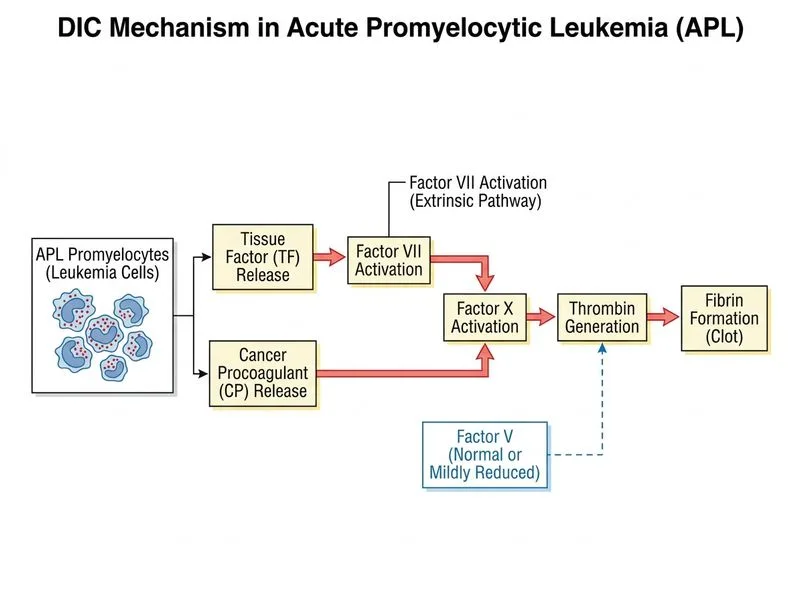
Sign up free to access AI-powered MCQ practice with detailed explanations and adaptive learning.
Daily MCQs, study tips, and topper strategies on Telegram.
Join on Telegram →