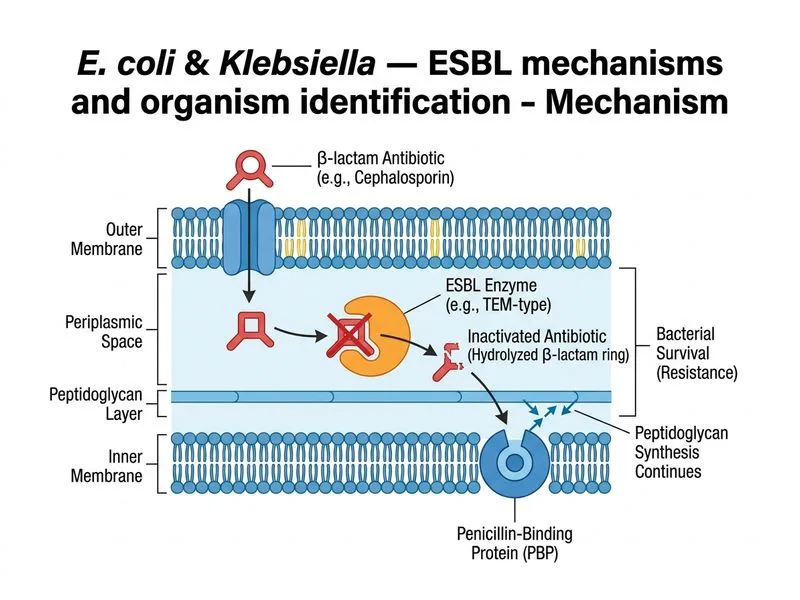
## Organism Identification The clinical and microbiological features point to **Klebsiella pneumoniae**: | Feature | Significance | |---------|---------------| | Mucoid colonies on MacConkey | Characteristic of K. pneumoniae (capsule-mediated mucoid appearance) | | Lactose fermentation | Positive in both E. coli and Klebsiella | | Gas production from glucose | Both organisms produce gas | | Methyl red positive | Indicates mixed acid fermentation pathway | | Motility | E. coli is motile; **K. pneumoniae is typically non-motile** | | Recurrent UTI with ESBL | K. pneumoniae is a common nosocomial uropathogen | **Key Point:** The motility reported in this case is unusual for K. pneumoniae, but the mucoid colony morphology on MacConkey agar is the most distinctive feature that identifies this organism. Some K. pneumoniae strains can show limited motility under certain conditions. ## ESBL Mechanism of Resistance **High-Yield:** ESBLs are serine β-lactamases that hydrolyze the β-lactam ring of third-generation cephalosporins (ceftriaxone, cefotaxime, ceftazidime) and monobactams (aztreonam). This is **enzymatic inactivation**, not altered binding proteins or efflux mechanisms. ### TEM vs. SHV vs. CTX-M ESBLs | ESBL Type | Origin | Common in | Mechanism | |-----------|--------|-----------|----------| | **TEM** | Transposon-derived (plasmid-borne) | E. coli, K. pneumoniae | Hydrolysis of β-lactam ring | | **SHV** | Chromosomal β-lactamase variant | K. pneumoniae (chromosomal origin) | Hydrolysis of β-lactam ring | | **CTX-M** | Environmental origin (Kluyvera) | E. coli (plasmid-borne) | Hydrolysis of β-lactam ring | **Clinical Pearl:** Although both TEM and SHV ESBLs occur in K. pneumoniae, **TEM-type ESBLs are more frequently encountered in clinical isolates** of K. pneumoniae causing UTIs and nosocomial infections. SHV ESBLs, while chromosomally encoded in K. pneumoniae, are less common in contemporary isolates. ## Why Option 0 Is Correct 1. **Mucoid morphology** → K. pneumoniae 2. **ESBL production** → Enzymatic hydrolysis of the β-lactam ring (the defining mechanism of all ESBLs) 3. **TEM-type ESBL** → Most common ESBL in K. pneumoniae causing UTI ## Mechanism of ESBL Resistance ```mermaid flowchart LR A[Third-generation Cephalosporin<br/>e.g., Ceftriaxone]:::action --> B[ESBL Enzyme<br/>Serine β-lactamase]:::action B --> C[Hydrolysis of β-lactam Ring]:::action C --> D[Inactivation of Antibiotic]:::outcome E[Clavulanic Acid<br/>β-lactamase Inhibitor] --> F[Inhibits ESBL]:::action F --> G[Restores Cephalosporin Activity]:::outcome ``` **Treatment:** Carbapenems (meropenem, imipenem) or β-lactam/β-lactamase inhibitor combinations (piperacillin-tazobactam) are used for ESBL-producing organisms.
Sign up free to access AI-powered MCQ practice with detailed explanations and adaptive learning.