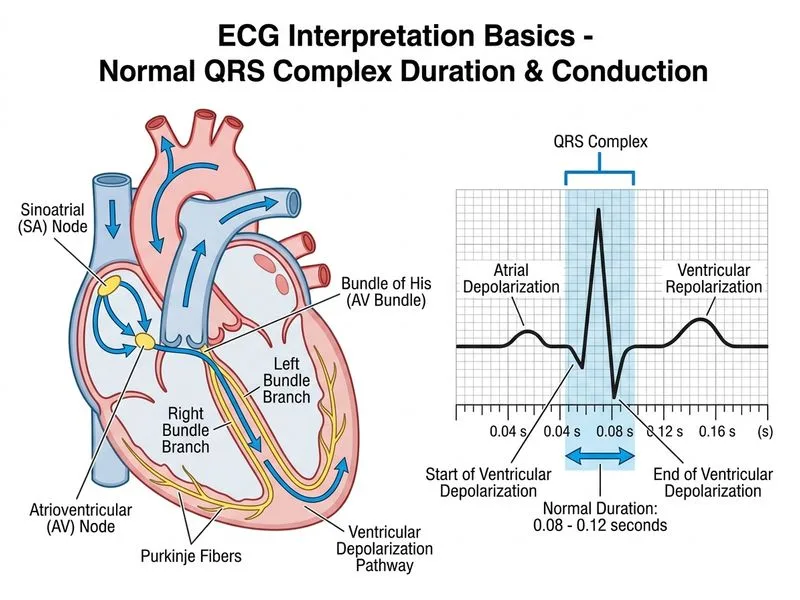
## Normal QRS Duration **Key Point:** The QRS complex represents ventricular depolarization and normally lasts between 0.08 and 0.12 seconds (80–120 milliseconds) on a standard ECG. ### Measurement Method - Count small squares on ECG paper: each small square = 0.04 seconds - Normal QRS = 2–3 small squares in width - Measured from the beginning of the Q wave (or R wave if no Q present) to the end of the S wave ### Clinical Significance | Duration | Interpretation | Clinical Significance | |----------|-----------------|----------------------| | < 0.08 s | Narrow QRS | Normal ventricular conduction | | 0.08–0.12 s | **Normal range** | **Standard reference** | | 0.12–0.20 s | Prolonged QRS | Ventricular conduction delay (RBBB, LBBB, hyperkalemia) | | > 0.20 s | Severely prolonged | Severe conduction abnormality or artifact | **High-Yield:** A QRS duration ≥ 0.12 seconds (≥ 3 small squares) is diagnostic of bundle branch block and is a key criterion in NEET PG ECG questions. **Clinical Pearl:** Prolonged QRS (> 0.12 s) increases risk of sudden cardiac death and is a criterion for cardiac resynchronization therapy (CRT) eligibility in heart failure patients. 
Sign up free to access AI-powered MCQ practice with detailed explanations and adaptive learning.