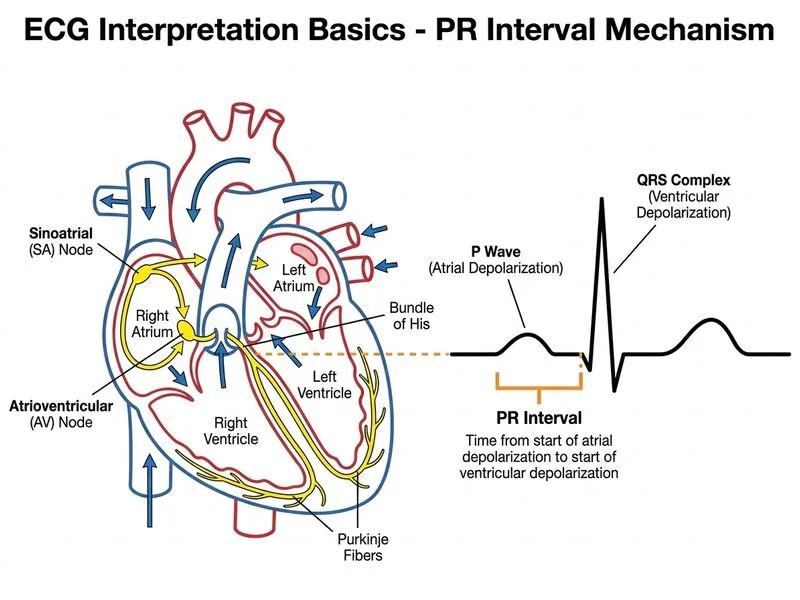
## PR Interval: Definition and Clinical Significance **Key Point:** The PR interval measures the time from the start of atrial depolarization (P wave) to the start of ventricular depolarization (QRS complex). It represents the total conduction time through the atria and the AV node. ### Anatomical Basis ```mermaid flowchart LR A["P wave<br/>(Atrial depolarization)"] -->|PR interval| B["QRS onset<br/>(Ventricular depolarization)"] A -->|Conduction path| C["Atria → AV node<br/>→ Bundle of His<br/>→ Purkinje fibers"] ``` ### Normal Values and Measurement | Parameter | Duration | Small Squares | Clinical Meaning | |-----------|----------|---------------|------------------| | **Normal PR interval** | **0.12–0.20 s** | **3–5 squares** | Normal AV conduction | | PR < 0.12 s | < 3 squares | Pre-excitation (WPW syndrome) | | PR > 0.20 s | > 5 squares | AV block (1st degree or higher) | **High-Yield:** The PR interval is measured from the **beginning of the P wave** to the **beginning of the QRS complex**, not from the end of P to the beginning of QRS. **Mnemonic:** **P-R = Pathway to Repolarization** — it shows how long the impulse takes to travel from the atria through the AV node to reach the ventricles. ### Clinical Pearls - **PR prolongation (> 0.20 s):** First-degree AV block; seen in hyperkalemia, digitalis toxicity, acute rheumatic fever - **PR shortening (< 0.12 s):** WPW syndrome, Lown-Ganong-Levine syndrome, atrial tachycardia - **Variable PR intervals:** Suggest AV dissociation or complete heart block - **PR depression:** Seen in atrial infarction or pericarditis 
Sign up free to access AI-powered MCQ practice with detailed explanations and adaptive learning.