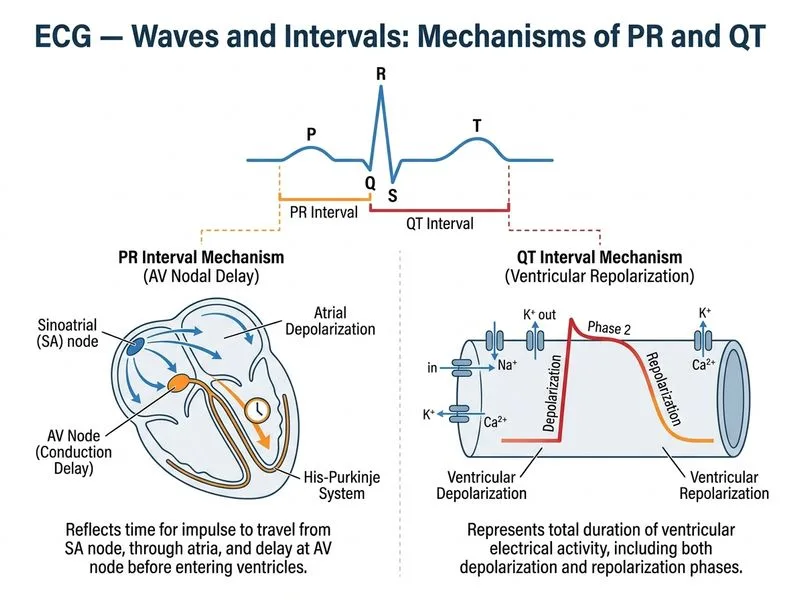
## Distinguishing PR Interval Prolongation from QT Prolongation ### Anatomical and Physiological Basis **Key Point:** The PR interval and QT interval represent conduction and repolarization in different cardiac compartments, and their response to physiological stress differs fundamentally. | Feature | PR Interval (First-Degree AV Block) | QT Interval (Prolongation) | |---------|--------------------------------------|---------------------------| | **Anatomical site** | AV node, bundle of His, bundle branches | Ventricular myocardium (repolarization phase) | | **Reflects** | Atrial depolarization + AV conduction delay | Ventricular depolarization + repolarization | | **Normal duration** | 120–200 ms | Varies with HR (corrected QTc: < 440 ms males, < 460 ms females) | | **Response to exercise** | May shorten (increased sympathetic tone, faster AV conduction) | Shortens (increased HR → shorter QT) | | **Pathophysiology** | Slowed conduction through AV node | Delayed repolarization (prolonged action potential) | ### Clinical Pearl **High-Yield:** The PR interval is a *conduction* interval (depolarization), while the QT interval is a *repolarization* interval. This distinction is critical: - **First-degree AV block** = slowed conduction → prolonged PR, normal QT - **Long QT syndrome** = delayed repolarization → normal PR, prolonged QT (corrected for rate) ### Mechanism of Differentiation The most reliable discriminator is the **physiological compartment involved**: 1. PR interval prolongation → AV nodal conduction delay (electrical pathway) 2. QT interval prolongation → ventricular repolarization delay (ion channel dysfunction or electrolyte abnormality) Both may coexist in certain conditions (e.g., amiodarone, hypocalcemia), but the *primary* pathophysiology differs. ### Practical Bedside Approach **Tip:** When analyzing an ECG: - Measure PR interval from start of P wave to start of QRS - Measure QT interval from start of QRS to end of T wave - Correct QT for heart rate using Bazett formula: $QTc = \frac{QT}{\sqrt{RR}}$ (RR in seconds) - If PR is prolonged but QTc is normal → first-degree AV block - If QTc is prolonged but PR is normal → repolarization abnormality [cite:Harrison 21e Ch 297] 
Sign up free to access AI-powered MCQ practice with detailed explanations and adaptive learning.