
## Notochord and Its Derivatives The notochord is a transient mesodermal structure that appears during the second week of development and plays a crucial role in induction and patterning of the embryo. ### Fate of the Notochord: - **Nucleus Pulposus**: The notochord gives rise to the nucleus pulposus of the intervertebral disc. This is the most clinically important derivative. - **Regression**: Most of the notochord regresses by the end of the embryonic period. - **Remnants**: Small remnants may persist as the **notochordal remnants**, which can occasionally give rise to chordomas (rare malignant tumors of the spine). ### Other Structures (NOT from notochord): - **Annulus fibrosus**: Derived from the sclerotomes of the somites (mesodermal origin, but NOT from notochord). - **Anterior and posterior longitudinal ligaments**: Derived from the ventral and dorsal mesodermal tissues surrounding the vertebral column, not from the notochord. **Key Point:** The notochord is a primary inducer during development and its primary derivative of clinical significance is the nucleus pulposus. This is a high-yield fact for NEET PG embryology. 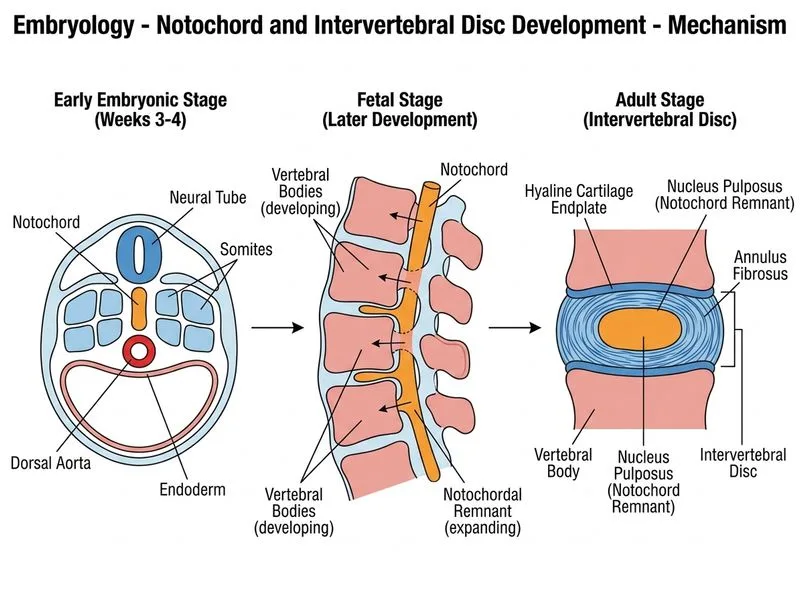
Sign up free to access AI-powered MCQ practice with detailed explanations and adaptive learning.