
## Embryological Basis of Duodenal Mesentery ### Development of the Duodenum The duodenum is derived from both **foregut** (proximal 1/3) and **midgut** (distal 2/3). The mesenteries of the duodenum have distinct embryological origins: - **Proximal duodenum (D1–D2):** Retains ventral mesentery (hepatoduodenal ligament) - **Distal duodenum (D3–D4):** Loses its dorsal mesentery during rotation of the midgut ### The Dorsal Mesentery of the Duodenum The **dorsal mesentery of the duodenum** is derived from the **dorsal pancreatic bud** and its associated peritoneal fold. During normal embryological development: 1. The dorsal pancreatic bud arises from the duodenum around week 4 2. It carries with it a fold of peritoneum (dorsal mesentery) 3. This mesentery normally fuses with the posterior peritoneum during weeks 6–8, obliterating the dorsal mesentery **Absence of the dorsal mesentery** indicates failure of the dorsal pancreatic bud to develop normally, as the mesentery is an integral part of the pancreatic bud's peritoneal attachment. ### Key Point: **The dorsal pancreatic bud and its mesentery are inseparable embryologically.** Failure of the dorsal pancreatic bud results in absence of the dorsal duodenal mesentery. ### Clinical Pearl: This embryological defect may be associated with: - Pancreatic agenesis (if both buds fail) - Annular pancreas (if ventral bud rotates abnormally) - Duodenal obstruction (if mesenteric anomalies persist) 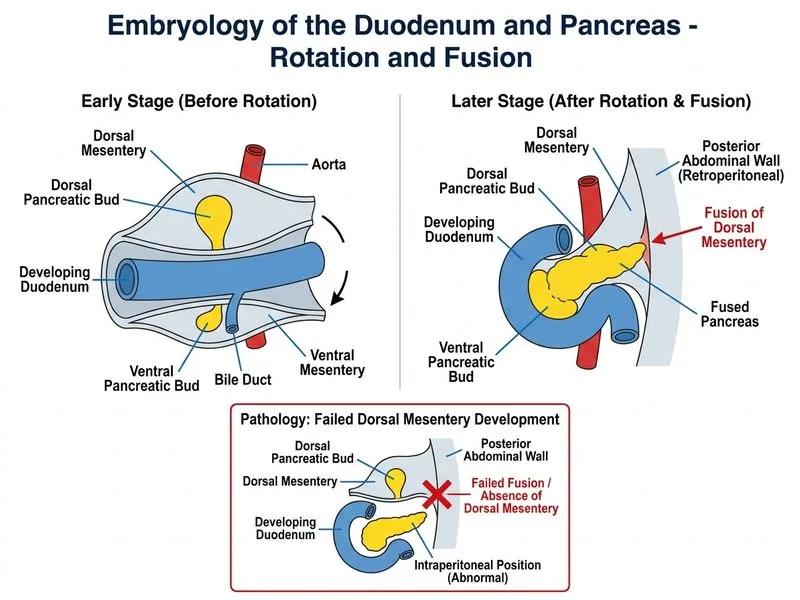
Sign up free to access AI-powered MCQ practice with detailed explanations and adaptive learning.