
Oblique fractures result from combined shear and axial forces applied to the bone. The 45° angle represents the plane of maximum shear stress in the bone under combined loading conditions.
| Fracture Type | Angle to Long Axis | Mechanism | Stability | Example |
|---|---|---|---|---|
| Transverse | 90° (perpendicular) | Direct blow; bending force | Unstable | Femoral shaft from direct trauma |
| Oblique | 45° (angled) | Shear + axial force | Moderately unstable | Tibia from twisting with compression |
| Spiral | Helical around shaft | Torsional (rotational) force | Unstable; soft tissue damage | Fibula from twisting injury |
| Greenstick | Incomplete; one cortex intact | Bending in children | Stable | Pediatric radius fracture |
Loading illustration…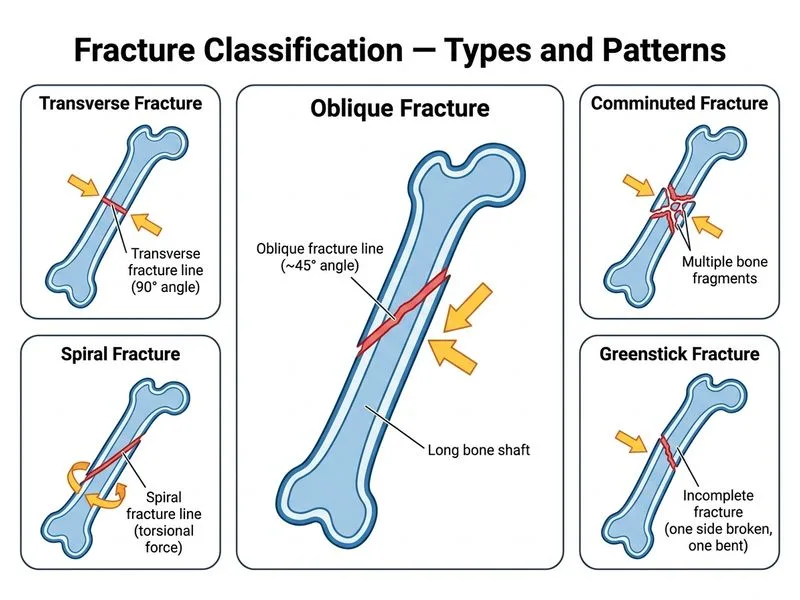
Sign up free to access AI-powered MCQ practice with detailed explanations and adaptive learning.
Daily MCQs, study tips, and topper strategies on Telegram.
Join on Telegram →