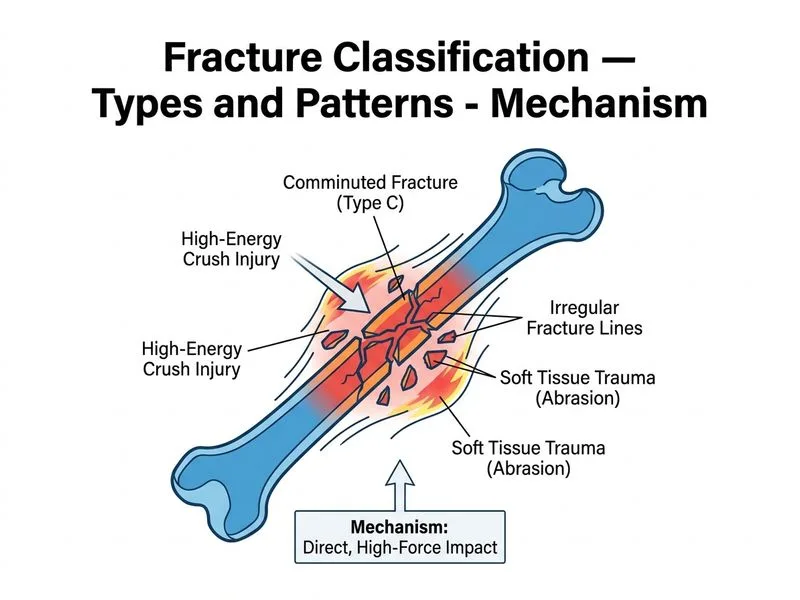
## AO/OTA Fracture Classification This is a **Type C (complex/comminuted) fracture** of the femur. ### Understanding the AO/OTA System **Key Point:** The AO/OTA classification divides long bone fractures into three main types based on fracture pattern complexity and prognosis: ### Classification Framework | Type | Pattern | Characteristics | Prognosis | Examples | |------|---------|-----------------|-----------|----------| | **A** | Simple | Two main fragments, no comminution | Excellent | Transverse, oblique, spiral (no comminution) | | **B** | Wedge | Butterfly/wedge fragment, but cortices intact on one side | Good to fair | Partial comminution, one cortex intact | | **C** | Complex | Complete comminution, no cortical continuity, multiple fragments | Poor | Segmental, severely comminuted fractures | ### Diagnostic Features of Type C Fracture 1. **Comminution**: Multiple bone fragments (>2 main pieces) 2. **Extent**: Comminution involves >50% of bone width (as in this case) 3. **Cortical continuity**: Loss of cortical continuity on both sides 4. **Fracture line**: Irregular, multidirectional pattern 5. **Mechanism**: High-energy trauma (crush injury, motor vehicle accident) 6. **Associated soft tissue injury**: Often present (as in this case) **High-Yield:** Type C fractures have the worst prognosis among simple long bone fractures due to: - Increased risk of non-union - Higher infection rate (especially with open fractures) - Greater soft tissue damage - More complex surgical reconstruction ### Clinical Pearl Type C fractures often require operative fixation (intramedullary nailing or plate fixation) and have longer healing times compared to Type A and B fractures. The presence of significant soft tissue trauma (as in this motorcyclist) further worsens the prognosis and increases infection risk. ### Mnemonic **ABC Fractures = Increasing Complexity** - **A** = **A**ll intact (simple, two fragments) - **B** = **B**utterfly/wedge (partial comminution) - **C** = **C**omplex/comminuted (multiple fragments, both cortices involved) ### Why This Is Type C The key findings are: - Multiple bone fragments (comminution) - Comminution >50% of bone width - Irregular, multidirectional fracture lines - High-energy mechanism - Associated soft tissue trauma All these features define a Type C fracture. [cite:Rockwood & Green's Fractures in Adults 9e Ch 1] 
Sign up free to access AI-powered MCQ practice with detailed explanations and adaptive learning.