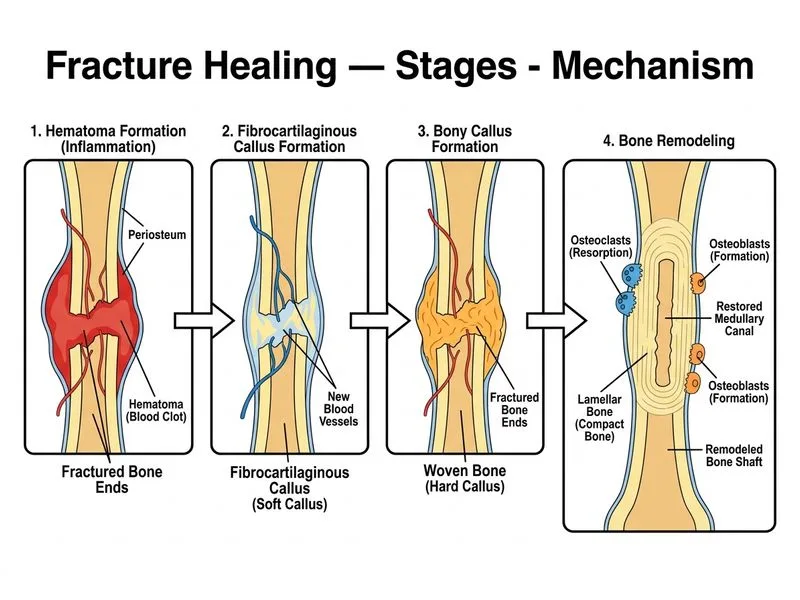
Which of the following cellular events is the primary hallmark of the remodeling phase of fracture healing?
A. Conversion of woven bone to lamellar bone and restoration of the medullary canal
B. Infiltration of macrophages and removal of necrotic tissue
C. Endochondral ossification and formation of hard callus
D. Proliferation of fibroblasts and formation of fibrocartilaginous matrix
Explanation
Remodeling Phase of Fracture Healing
Key Point
The remodeling phase is the final and longest phase of fracture healing, characterized by the conversion of immature woven bone into mature lamellar bone and restoration of normal bone architecture.
Timeline and Characteristics
Timing: Months to years (can continue for 5–7 years in some cases)
Primary Events:
1.
Osteoclasts remove woven bone along stress lines.
2.
Osteoblasts deposit lamellar bone in organized, stress-aligned patterns.
3.
Medullary canal is restored through osteoclastic resorption.
4.
Bone returns to its original shape and strength.
High-YieldNEET PG
The remodeling phase is osteoclast-driven initially (removal of poorly organized woven bone) followed by osteoblast-driven deposition of mature lamellar bone. This is why the phase is so prolonged—it requires careful, organized bone remodeling.
Comparison with Other Phases
Table
Phase
Duration
Key Process
Bone Type
Inflammatory
0–3 days
Hematoma, inflammation
None
Soft Callus
1–3 weeks
Fibrocartilage formation
Fibrocartilage
Hard Callus
3–12 weeks
Endochondral ossification
Woven bone
Remodeling
Months–years
Woven → lamellar bone
Lamellar bone
Clinical Pearl
Even after a fracture appears "healed" on X-ray (hard callus phase, ~12 weeks), the bone is still mechanically weaker than normal because it is composed of disorganized woven bone. Full strength is not regained until the remodeling phase is well advanced (typically 6–12 months for weight-bearing bones).
Mnemonic
W→L = Woven bone → Lamellar bone. Remember: Remodeling = Refinement, not formation.
Loading illustration…
Practice similar questions
Sign up free to access AI-powered MCQ practice with detailed explanations and adaptive learning.