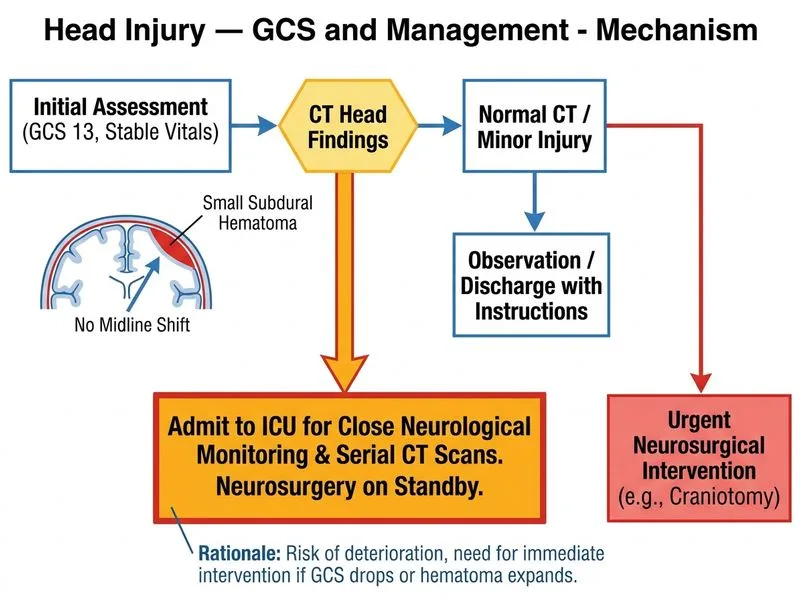
A 28-year-old male construction worker is brought to the emergency department 45 minutes after a fall from scaffolding onto concrete. On arrival, he is alert but confused, with a GCS of 13 (E3V4M6). His pupils are equal and reactive. CT head shows a small subdural hematoma without midline shift. Blood pressure is 128/82 mmHg, heart rate 92/min, respiratory rate 18/min. After initial stabilization, what is the most appropriate next step in management?
A. Discharge home with head injury precautions and outpatient neurosurgery follow-up in 48 hours
B. Immediate neurosurgical consultation and operative evacuation
C. Start mannitol and hyperventilation; proceed to OR if GCS drops by 2 or more points
D. Admit to ICU for close neurological monitoring with serial CT scans; neurosurgery on standby
Explanation
Management of Acute Subdural Hematoma with GCS 13
Key Point
A patient with GCS 13 and a small subdural hematoma without midline shift or mass effect is classified as a moderate head injury. The absence of neurological deterioration, pupillary changes, or significant mass effect does NOT mandate immediate surgery.
High-YieldNEET PG
Management of acute subdural hematoma depends on:
1.
Volume and mass effect (midline shift, compression of ventricles)
2.
GCS score (reflects severity)
3.
Pupillary status (indicates herniation risk)
4.
Neurological trajectory (improving vs. deteriorating)
Decision Algorithm for Acute SDH
Loading diagram...
Clinical Pearl
Small acute SDH (thickness < 10 mm, no midline shift) in a patient with GCS ≥ 13 and stable pupils can be managed non-operatively with:
ICU-level care for continuous monitoring
Serial neurological examinations (q1h initially)
Repeat CT if there is ANY deterioration
Neurosurgery on standby (not routine OR)
Warning
Do NOT discharge home immediately — even small SDH can expand or cause delayed deterioration. The patient requires ICU monitoring for at least 24–48 hours.
Mnemonic: SDHS (Subdural Hematoma Surgery criteria)
Shift (midline shift present) → Surgery
Deterioration (GCS drop ≥2) → Surgery
Herniation signs (blown pupil) → Surgery
Small SDH + stable → Supportive care + monitor
ATLS 10th Edition, Chapter 4: Initial Assessment and Management
Loading illustration…
Practice similar questions
Sign up free to access AI-powered MCQ practice with detailed explanations and adaptive learning.