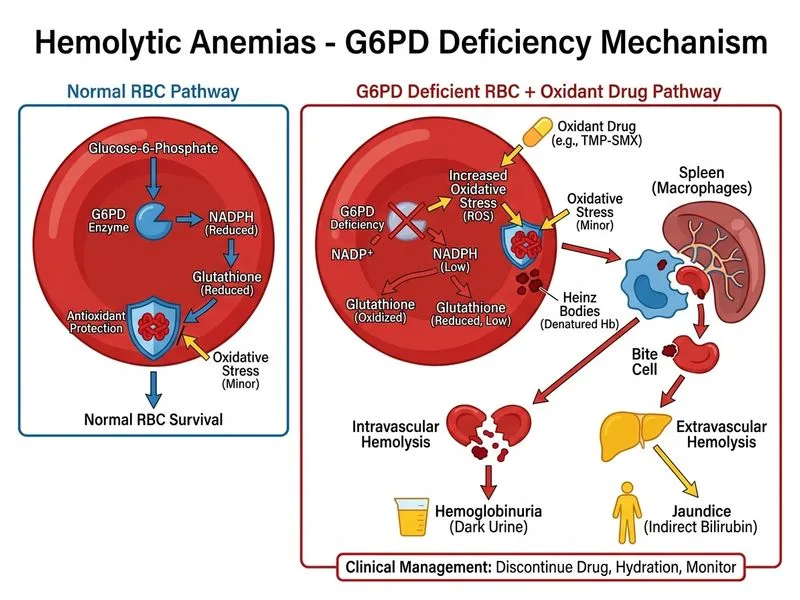
## Clinical Diagnosis This patient has **glucose-6-phosphate dehydrogenase (G6PD) deficiency** with acute hemolytic crisis triggered by an oxidative stressor (trimethoprim-sulfamethoxazole). **Key Point:** The diagnostic triad is: 1. **Bite cells** — RBCs with a "bitten" appearance from Heinz body removal by splenic macrophages 2. **Heinz bodies** — precipitated denatured hemoglobin (visible only on supravital staining, NOT on routine smear) 3. **Negative DAT** — rules out immune-mediated hemolysis **High-Yield:** G6PD deficiency is X-linked recessive; African males have the highest prevalence (10–15%). Hemolytic crises are **self-limited** if the oxidative trigger is removed. ## Pathophysiology of G6PD Hemolysis ```mermaid flowchart TD A[G6PD Deficiency]:::outcome --> B[Reduced NADPH production]:::outcome B --> C[Impaired glutathione reduction]:::outcome C --> D[Accumulation of reactive oxygen species]:::urgent D --> E[Hemoglobin denaturation → Heinz bodies]:::outcome E --> F[Splenic removal of Heinz bodies]:::outcome F --> G[Bite cells on smear]:::outcome G --> H[Hemolysis + Hemoglobinuria]:::outcome I[Oxidative Trigger]:::urgent --> B I -->|e.g. TMP-SMX, dapsone, aspirin| J[Acute Hemolytic Crisis] J --> K{Remove Trigger?}:::decision K -->|Yes| L[Crisis self-resolves in days]:::action K -->|No| M[Continued hemolysis]:::urgent ``` ## Management of Acute G6PD Crisis | Step | Intervention | Rationale | |------|--------------|----------| | **Immediate** | Discontinue offending drug | Removes oxidative stress; allows RBC recovery | | **Immediate** | IV hydration (0.9% saline) | Prevents acute kidney injury from hemoglobinuria | | **Monitoring** | Urinalysis, urine output, serum creatinine | Detect hemoglobinuria and renal dysfunction | | **Supportive** | Transfusion only if Hb <7 or symptomatic | Avoid unnecessary transfusion; crisis is self-limited | | **Prevention** | Folic acid 5 mg daily during recovery | Supports RBC regeneration (given AFTER acute phase) | | **Education** | Avoid triggers: sulfonamides, NSAIDs, fava beans, infections | Prevent future crises | **Mnemonic: G6PD Crisis Management = DHUM (Discontinue drug, Hydrate, Urine monitor, Manage supportively)** ## Why This Option Is Correct The four pillars of immediate management are: 1. **Drug discontinuation** — removes the oxidative trigger and allows hemolysis to resolve 2. **Hydration** — prevents acute tubular necrosis from hemoglobin precipitation in renal tubules 3. **Urine monitoring** — detects hemoglobinuria (dark/cola-colored urine) and guides fluid replacement 4. **Observation** — G6PD crises are self-limited; hemolysis stops within 7–10 days if trigger is removed **Clinical Pearl:** Unlike AIHA (which requires corticosteroids) or hereditary spherocytosis (which may need splenectomy), G6PD hemolysis resolves spontaneously once the oxidative stressor is removed. The patient's reticulocyte count (12%) indicates brisk bone marrow response. 
Sign up free to access AI-powered MCQ practice with detailed explanations and adaptive learning.