Which viral protein is the primary target of acyclovir in the treatment of herpes simplex virus infection?
A. Viral thymidine kinase
B. Viral glycoprotein G
C. Viral DNA polymerase
D. Viral helicase-primase complex
Explanation
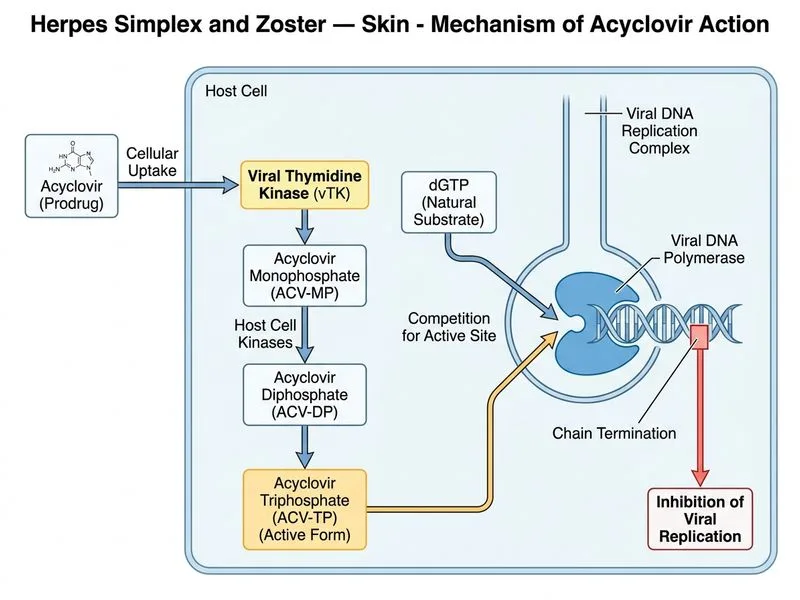
Mechanism of Acyclovir Action
Key Point
Acyclovir is a nucleoside analogue that selectively inhibits viral DNA polymerase, not the viral enzyme that phosphorylates it.
Why Viral DNA Polymerase?
Acyclovir undergoes a three-step phosphorylation process:
1.
Viral thymidine kinase (TK) phosphorylates acyclovir to acyclovir monophosphate
2.
Cellular enzymes convert it to acyclovir triphosphate
3.
Acyclovir triphosphate competitively inhibits viral DNA polymerase and causes chain termination
High-YieldNEET PG
The selectivity of acyclovir for HSV-infected cells depends on:
High levels of viral thymidine kinase in infected cells
Viral DNA polymerase has 40–200 times higher affinity for acyclovir triphosphate than cellular DNA polymerase
This explains why acyclovir has minimal toxicity to uninfected host cells
Viral Thymidine Kinase — Not the Direct Target
While viral TK is essential for acyclovir activation, it is not the target of inhibition. TK-deficient HSV mutants are resistant to acyclovir because the drug cannot be phosphorylated, not because TK itself is blocked.
Clinical Pearl
Acyclovir-resistant HSV strains typically have mutations in viral TK (most common) or viral DNA polymerase (less common), confirming that DNA polymerase is the final therapeutic target.
Harrison 21e Ch 187
Loading illustration…
Practice similar questions
Sign up free to access AI-powered MCQ practice with detailed explanations and adaptive learning.