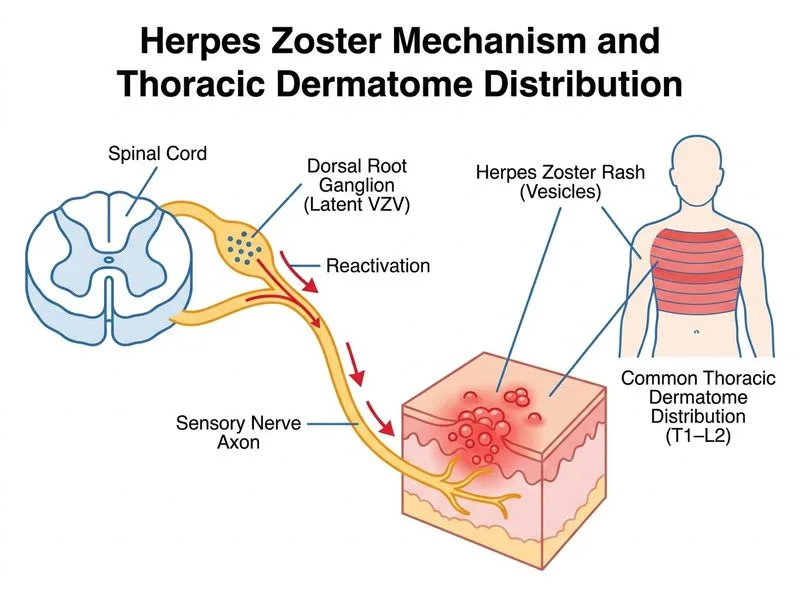
## Dermatome Distribution in Herpes Zoster **Key Point:** Thoracic dermatomes account for approximately 50–60% of all herpes zoster cases, making them the single most common site of involvement. ### Frequency of Zoster by Dermatome | Dermatome Region | Frequency | Clinical Notes | |---|---|---| | **Thoracic (T1–L2)** | **50–60%** | Most common; typically unilateral, follows rib distribution | | Cervical (C2–C4) | 10–20% | Second most common | | Lumbar/Sacral (L1–S5) | 10–15% | Lower frequency | | Ophthalmic (V1) | 10–15% | Risk of ocular complications; requires urgent ophthalmology referral | | Other cranial nerves | 5–10% | Ramsay Hunt syndrome (CN VII), CN V2/V3 | **High-Yield:** The thoracic distribution is so common that zoster should be suspected in any patient presenting with unilateral vesicular rash in a dermatomal pattern across the chest or trunk. ### Why Thoracic Dermatomes? 1. **Larger surface area:** Thoracic region covers a large body surface, increasing the probability of reactivation 2. **Dorsal root ganglia density:** The thoracic spinal ganglia have high numbers of latent VZV-infected neurons 3. **Mechanical factors:** Thoracic dermatomes are less mobile than extremities, potentially affecting viral reactivation kinetics **Clinical Pearl:** Thoracic zoster typically presents as a unilateral vesicular rash following one or more ribs, often preceded by dermatomal pain or hyperesthesia. Post-herpetic neuralgia (PHN) is common in this distribution, especially in elderly patients. **Mnemonic:** **THORAX** — **T**horacic zoster is most common, followed by **H**ead (V1/V2/V3), **O**ther cervical, **R**adicular pain precedes rash, **A**cute phase 7–10 days, **X**-ray (imaging) rarely needed for diagnosis. [cite:Park 26e Ch 8] 
Sign up free to access AI-powered MCQ practice with detailed explanations and adaptive learning.