NEETPGAI
FeaturesNEET PGFMGEINI-CETBlogPricing
Log inStart Free
NEETPGAI

AI-powered NEET PG preparation platform. Master all 19 subjects with adaptive MCQs, AI tutoring, and spaced repetition.

Product

  • Features
  • Subjects
  • Previous Year Questions
  • NEET PG Preparation
  • FMGE Preparation
  • INI-CET Preparation
  • Compare
  • Pricing
  • Blog

Features

  • Adaptive MCQ Practice
  • AI Tutor
  • Mock Tests
  • Spaced Repetition

Resources

  • Blog
  • Study Guides
  • NEET PG Updates
  • Contact & support

Legal

  • Privacy Policy
  • Terms of Service

Stay updated

© 2026 NEETPGAI. All rights reserved.
    Subjects/Dermatology/Herpes Simplex and Zoster — Skin
    Herpes Simplex and Zoster — Skin
    hard
    hand Dermatology

    A 28-year-old man with newly diagnosed HIV (CD4 count 85 cells/μL) presents with severe pain and vesicular eruption in the ophthalmic division (V1) of the trigeminal nerve on the right side. Vesicles are present on the tip of the nose and right eyelid. He denies prior chickenpox but was vaccinated against varicella as a child. Ophthalmology confirms corneal involvement. What is the most appropriate immediate management?

    A. Oral valacyclovir 1000 mg three times daily for 7 days with topical antibiotic ointment
    B. Observation with analgesia alone; await CD4 recovery on antiretroviral therapy
    C. Intravenous acyclovir 10–15 mg/kg 8-hourly, urgent ophthalmology follow-up, and initiation of antiretroviral therapy
    Topical acyclovir eye ointment and systemic NSAIDs for pain control
    D.

    Explanation

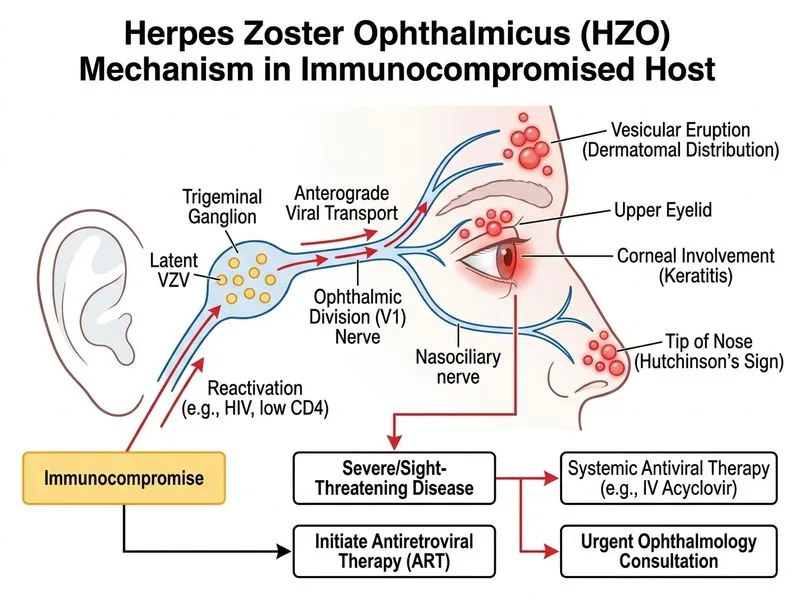
    Herpes Zoster Ophthalmicus in Advanced HIV: Urgent Management

    Clinical Context: Hutchinson's Sign
    Key Point
    Vesicles on the tip of the nose (Hutchinson's sign) indicate involvement of the nasociliary branch of V1 and predict a 50% risk of ocular complications, including corneal scarring, uveitis, and vision loss. This is a dermatologic emergency.
    Why IV Acyclovir Is Mandatory
    Table
    CriterionRationale
    CD4 <100Severe immunosuppression increases risk of disseminated VZV, post-herpetic neuralgia, and ocular complications
    Corneal involvementRequires high CNS/aqueous humor penetration; IV acyclovir achieves superior levels vs. oral formulations
    V1 distributionOphthalmic zoster carries 50–70% risk of ocular sequelae if not aggressively treated
    Systemic riskCD4 <100 confers risk of VZV vasculopathy (stroke) and disseminated disease
    Treatment Algorithm
    Loading diagram...
    Dosing & Duration
    High-YieldNEET PG
    IV acyclovir for disseminated or ophthalmic zoster in immunocompromised hosts:
    • Dose: 10–15 mg/kg IV every 8 hours
    • Duration: 10–14 days (longer than immunocompetent hosts)
    • Renal monitoring: Adjust for creatinine clearance; risk of crystalline nephropathy
    Adjunctive Management
    1. 1.
      Ophthalmology co-management: Essential for corneal assessment, anterior chamber inflammation, and potential need for topical corticosteroids (controversial; may increase risk of dissemination but may reduce inflammation)
    2. 2.
      Antiretroviral therapy: Initiate or optimize; CD4 recovery is the ultimate goal
    3. 3.
      Analgesia: Pregabalin 150–600 mg/day or gabapentin for neuropathic pain
    4. 4.
      Monitoring: Watch for immune recovery uveitis (IRU) as CD4 rises >100 cells/μL
    Why Oral Antivirals Are Insufficient
    Warning
    Oral valacyclovir achieves only ~50% of IV acyclovir CSF/aqueous humor levels. In CD4 <100 with corneal involvement, oral therapy risks:
    • Inadequate viral suppression
    • Progressive corneal scarring
    • Disseminated VZV (meningitis, vasculopathy)
    Mnemonic: CORNEAL Zoster in Advanced HIV
    • CD4 <100 → IV therapy mandatory
    • Ophthalmic division (V1) → high complication risk
    • Retinal/corneal involvement → urgent ophthalmology
    • Needs IV acyclovir 10–15 mg/kg 8-hourly
    • Emergency: dissemination risk (meningitis, stroke)
    • ART optimization essential for immune recovery
    • Long-term: monitor for immune recovery uveitis
    Clinical Pearl
    Hutchinson's sign (vesicles on nose tip) is a clinical red flag for ocular involvement and should trigger immediate ophthalmology referral and IV antiviral therapy, regardless of CD4 count.

    Loading illustration…Herpes Simplex and Zoster — Skin diagram

    Practice similar questions

    Sign up free to access AI-powered MCQ practice with detailed explanations and adaptive learning.

    Start Practicing Free More Dermatology Questions

    Join our NEET PG community

    Daily MCQs, study tips, and topper strategies on Telegram.

    Join on Telegram →