Herpes Simplex and Zoster — Skin MCQ — NEET PG Practice Question | NEETPGAI
Herpes Simplex and Zoster — Skin
medium
hand Dermatology
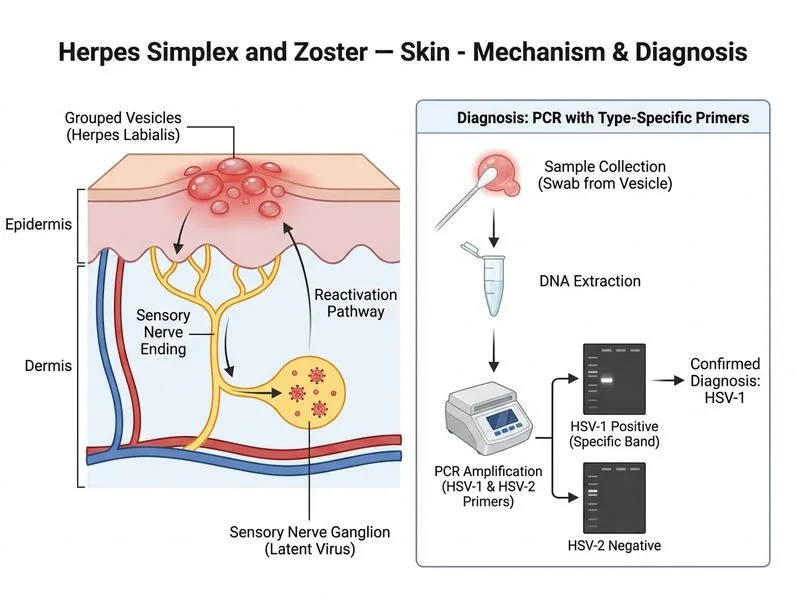
A 28-year-old man with recurrent labial herpes simplex presents with grouped vesicles on the lip for 2 days. He has had 5 episodes in the past year. Which investigation is most specific for confirming HSV-1 and differentiating it from HSV-2?
A. Viral culture followed by type-specific serology
B. Tzanck smear with Giemsa staining
C. PCR with HSV-1/HSV-2 type-specific primers
D. Immunofluorescence with type-specific monoclonal antibodies
Explanation
Investigation of Choice for HSV Type Differentiation
Clinical Context
The patient has recurrent labial herpes, consistent with HSV-1 (oral) reactivation. Identifying the specific HSV type (HSV-1 vs. HSV-2) is important for:
Counseling on transmission risk
Predicting recurrence patterns (HSV-1 reactivates less frequently than HSV-2 in genital disease)
Guiding antiviral prophylaxis decisions
Diagnostic Methods for HSV Type Differentiation
Table
Investigation
Differentiates HSV-1/2
Sensitivity
Speed
Practical Use
PCR with type-specific primers
Yes
95–99%
24–48 hrs
Gold standard
Viral culture + serology
Yes
60–80%
5–14 days + serology
Slower; serology may not reflect current infection
Immunofluorescence (type-specific mAb)
Yes
80–90%
24 hrs
Requires expertise; less sensitive than PCR
Tzanck smear
No
60–80%
Immediate
Cannot differentiate HSV-1 from HSV-2
Why Type-Specific PCR is Superior
Key Point
PCR with HSV-1/HSV-2 type-specific primers is the most specific and sensitive method because it:
1.
Directly amplifies and detects type-specific viral DNA sequences
2.
Achieves 95–99% sensitivity and >99% specificity
3.
Provides rapid results (24–48 hours)
4.
Requires minimal sample (vesicular fluid, saliva, or swab)
Genital herpes (HSV-1 or HSV-2; type affects prognosis and counseling)
Neonatal herpes (HSV-2 has higher dissemination risk)
Immunocompromised patients (rapid confirmation guides IV acyclovir initiation)
Clinical Pearl
Serology (IgG anti-HSV-1 vs. anti-HSV-2) can differentiate types but reflects past exposure, not current infection type — especially unreliable in recurrent disease where both IgG antibodies may be present.
Mnemonic: "PCR Primers = Precise Type Identification"
Precise: Type-specific detection
Confirms: Both HSV-1 and HSV-2
Rapid: 24–48 hour turnaround
Loading illustration…
Practice similar questions
Sign up free to access AI-powered MCQ practice with detailed explanations and adaptive learning.