Impetigo and Staphylococcal Skin Infections MCQ — NEET PG Practice Question | NEETPGAI
Impetigo and Staphylococcal Skin Infections
easy
hand Dermatology
A 6-year-old child presents with honey-crusted lesions on the face and exposed areas of the body for 3 days. The lesions are non-bullous and painless. Which investigation is most appropriate to confirm the diagnosis and guide antibiotic therapy?
A. KOH mount preparation
B. Tzanck smear
C. Bacterial antigen detection by ELISA
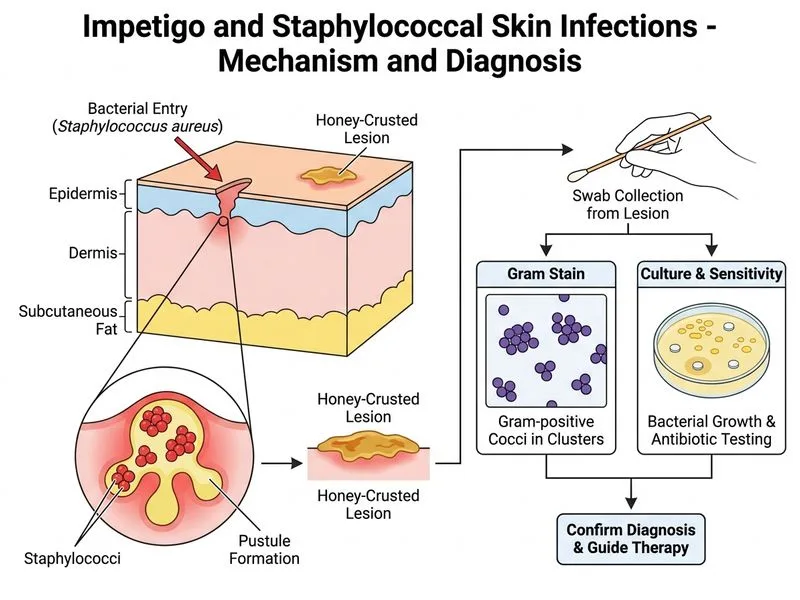
D. Gram stain and culture from the lesion
Explanation
Investigation of Choice in Non-Bullous Impetigo
Key Point
Gram stain and culture from the lesion is the gold standard for confirming bacterial impetigo and identifying the causative organism (Staphylococcus aureus or Streptococcus pyogenes).
Why Gram Stain and Culture?
1.
Organism Identification
Gram stain shows Gram-positive cocci in clusters (S. aureus) or chains (S. pyogenes)
Culture confirms the organism and allows antibiotic susceptibility testing (AST)
Essential in the era of MRSA to guide empiric therapy
Guides choice between β-lactams, cloxacillin, or glycopeptides
Reduces treatment failure and prevents resistance spread
3.
Clinical Correlation
Non-bullous impetigo (70% of cases) typically caused by S. aureus
Bullous impetigo caused by exfoliative toxin-producing S. aureus
Culture differentiates from other bacterial skin infections
High-YieldNEET PG
In India, MRSA prevalence in community impetigo is rising; culture-guided therapy is increasingly important.
Specimen Collection
Swab the base of the lesion (not the crust alone)
Transport in sterile tube or culture medium
Best yield before topical antibiotics are applied
Clinical Pearl
In uncomplicated non-bullous impetigo with typical presentation, empiric topical antibiotics (mupirocin) may be started; culture confirms diagnosis and guides escalation if needed.
Fitzpatrick's Dermatology in General Medicine Ch 195
Loading illustration…
Practice similar questions
Sign up free to access AI-powered MCQ practice with detailed explanations and adaptive learning.