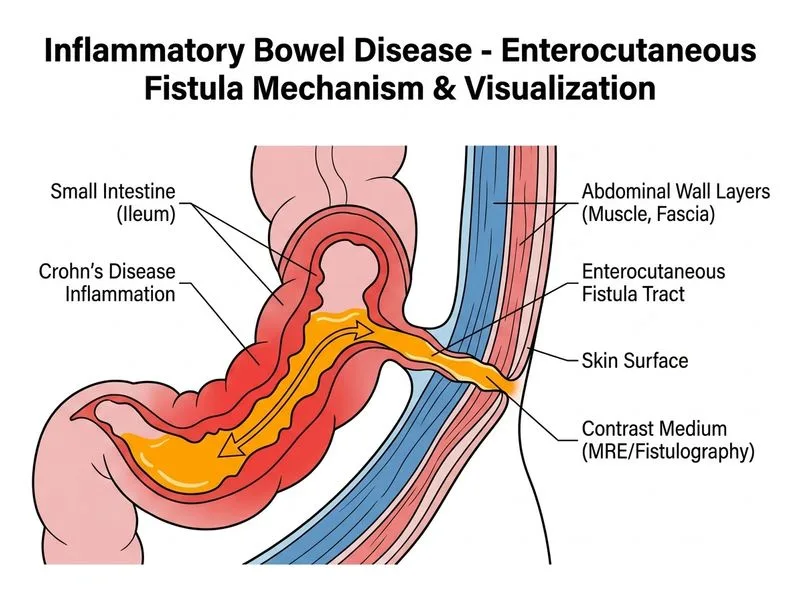
## Investigation of Choice for Fistula Assessment in Crohn's Disease ### Why MR Enterography with Fistulography is Superior **Key Point:** Magnetic resonance enterography (MRE) with fistulography is the gold standard for detecting and characterizing fistulas in Crohn's disease. It provides excellent soft tissue contrast without radiation and defines fistula anatomy, branching, and relationship to surrounding structures. ### Advantages of MRE with Fistulography | Feature | MRE with Fistulography | Barium Follow-Through | CT Enterography | |---------|------------------------|----------------------|------------------| | **Radiation** | None | Yes | Yes | | **Soft tissue detail** | Excellent | Poor | Good | | **Fistula detection** | 90-95% sensitivity | 60-70% | 85-90% | | **Abscess detection** | Excellent | Poor | Good | | **Functional assessment** | Yes (diffusion) | No | Limited | | **Small bowel detail** | Excellent | Good | Good | **High-Yield:** MRE is the imaging modality of choice for: - Detecting fistulas and sinus tracts - Assessing fistula complexity (simple vs. complex) - Identifying associated abscesses - Evaluating small bowel disease extent - Pre-operative surgical planning ### Fistula Classification (Relevant to Crohn's) 1. **Simple fistula:** Single tract, no abscess 2. **Complex fistula:** Multiple tracts, branching, associated abscess, or horseshoe configuration **Clinical Pearl:** MRE with fistulography uses gadolinium-enhanced sequences and T2-weighted imaging to visualize fistula tracts as high-signal-intensity lines. This is superior to barium studies, which may miss internal fistulas entirely. **Warning:** Barium studies can cause peritonitis if perforation is present — they are contraindicated in acute complicated Crohn's disease. MRI is safer in this context. 
Sign up free to access AI-powered MCQ practice with detailed explanations and adaptive learning.