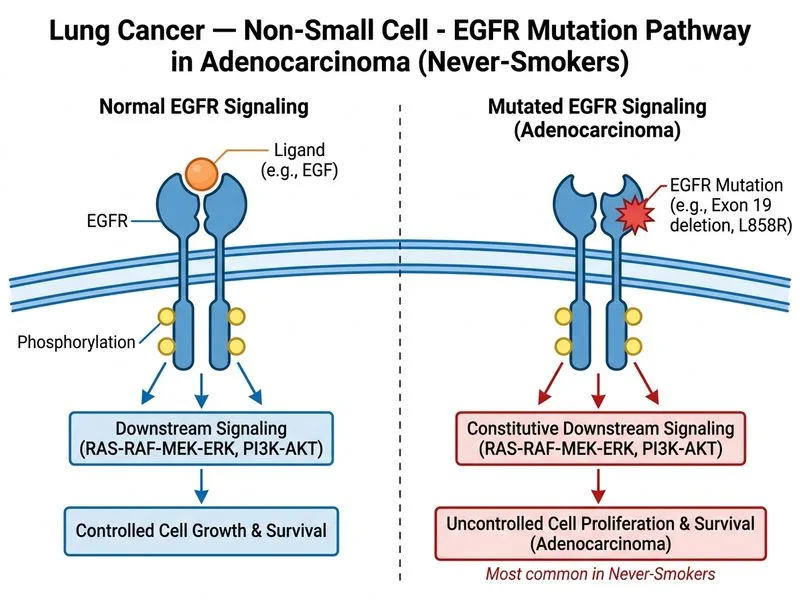
## EGFR Mutations in Lung Adenocarcinoma **Key Point:** EGFR (Epidermal Growth Factor Receptor) mutations are the most frequent actionable mutations in adenocarcinoma, particularly in never-smokers, females, and East Asian populations. ### Epidemiology & Association - **EGFR mutations** occur in 10–15% of Western lung adenocarcinomas but up to 30–50% in Asian populations - Strongly associated with **never-smokers** (>40% of never-smoker adenocarcinomas harbour EGFR mutations) - More common in **females** and **younger patients** - Rare in squamous cell carcinoma and small cell lung cancer ### Clinical Significance - **Predictive marker** for response to EGFR tyrosine kinase inhibitors (TKIs): erlotinib, gefitinib, afatinib - Patients with EGFR mutations have **superior progression-free survival** with TKI monotherapy vs. chemotherapy - Exon 19 deletions and exon 21 L858R point mutations account for ~90% of sensitizing mutations ### Contrast with Other Mutations | Mutation | Frequency in Adenocarcinoma | Smoker Association | Clinical Implication | |----------|----------------------------|-------------------|----------------------| | **EGFR** | 10–15% (West), 30–50% (Asia) | Never-smokers | TKI-sensitive | | **KRAS** | 25–30% | Smokers | Chemotherapy, emerging targeted agents | | **TP53** | 50% | Smokers | Poor prognosis, not actionable | | **ALK** | 3–5% | Never-smokers | ALK inhibitors (crizotinib, alectinib) | **High-Yield:** EGFR mutation testing is **mandatory** in all adenocarcinomas, especially in never-smokers, to guide first-line TKI therapy. **Clinical Pearl:** Presence of EGFR mutation is associated with **better initial response** to therapy but risk of acquired resistance via secondary mutations (e.g., T790M). 
Sign up free to access AI-powered MCQ practice with detailed explanations and adaptive learning.