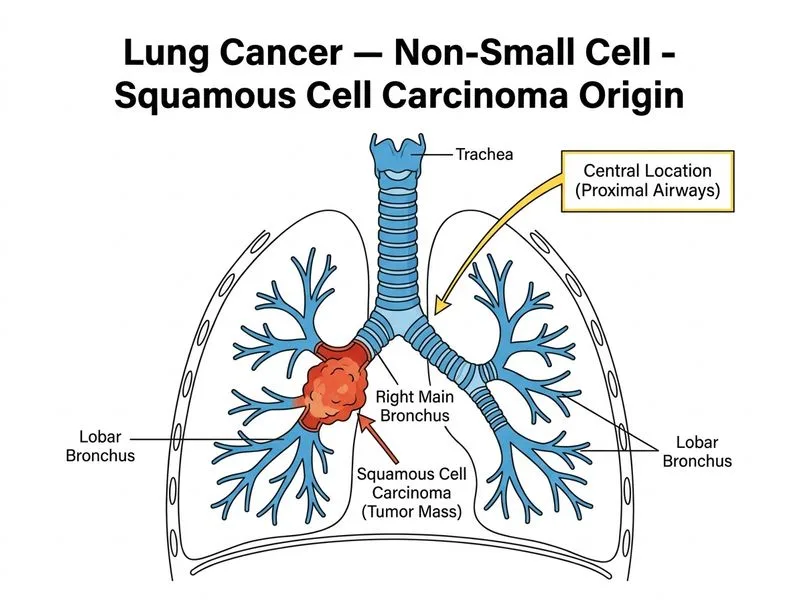
## Anatomical Origin of Lung Squamous Cell Carcinoma **Key Point:** Squamous cell carcinoma (SCC) of the lung arises from the **proximal airways** — lobar and main bronchi — where the respiratory epithelium undergoes squamous metaplasia in response to chronic irritation (smoking). ### Origin & Pathogenesis 1. **Chronic smoking** → irritation of proximal bronchial epithelium 2. **Squamous metaplasia** → replacement of normal ciliated columnar epithelium with stratified squamous epithelium 3. **Dysplasia** → low-grade → high-grade dysplasia 4. **Carcinoma** → invasive squamous cell carcinoma ### Anatomical Predilection - **Lobar and main bronchi** (central airways) — **most common site** - Hilar location → **central lung mass** on imaging - Proximal location makes it **accessible to bronchoscopy** for diagnosis - Contrast: adenocarcinoma arises in **peripheral lung** (distal airways, alveoli) ### Clinical Implications | Feature | Squamous Cell Carcinoma | Adenocarcinoma | |---------|------------------------|----------------| | **Location** | Central (lobar/main bronchi) | Peripheral (distal airways) | | **Smoking** | Strongly associated | Weakly associated | | **Metaplasia** | Squamous | Mucous/glandular | | **Cavitation** | Common | Rare | | **Bronchoscopy** | Accessible | Often not visible | **High-Yield:** SCC = **central hilar mass** in a **smoker**. This is a classic imaging-pathology correlation tested in NEET PG. **Clinical Pearl:** Central location and accessibility to bronchoscopy make SCC easier to diagnose histologically compared to peripheral adenocarcinoma, which often requires CT-guided biopsy or resection specimen. 
Sign up free to access AI-powered MCQ practice with detailed explanations and adaptive learning.