Lung Cancer — Non-Small Cell MCQ — NEET PG Practice Question | NEETPGAI
Lung Cancer — Non-Small Cell
medium
microscope Pathology
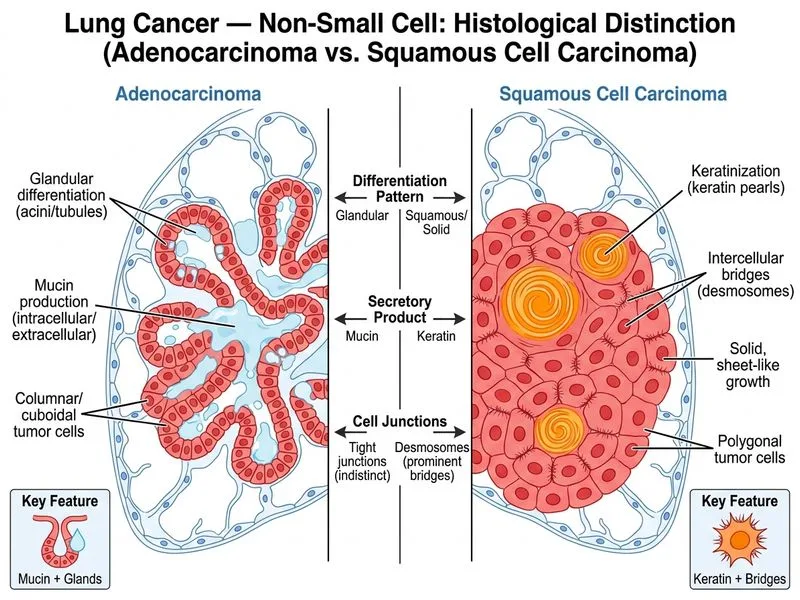
Which histological feature best distinguishes adenocarcinoma from squamous cell carcinoma of the lung?
A. Central location in the hilum with early bronchial involvement
B. Strong association with smoking history and cavitation
C. Presence of keratin pearls and intercellular bridges
D. Mucin production and glandular differentiation
Explanation
Distinguishing Adenocarcinoma from Squamous Cell Carcinoma
Histological Features Comparison
Table
Feature
Adenocarcinoma
Squamous Cell Carcinoma
Mucin production
Present (PAS+, mucicarmine+)
Absent
Glandular structures
Yes — acini, papillae
No
Keratin pearls
Absent
Present (hallmark)
Intercellular bridges
Absent
Present (desmosomes)
Location
Peripheral (distal airways)
Central (proximal bronchi)
Smoking association
Weak (can occur in non-smokers)
Strong (>90% smokers)
Key Point
Mucin production and glandular differentiation are the defining features of adenocarcinoma. Mucin can be demonstrated with special stains (PAS, mucicarmine, Alcian blue).
High-YieldNEET PG
Adenocarcinoma is the most common NSCLC subtype (~40%), and it is the only major lung cancer type that occurs more frequently in non-smokers and in women.
Clinical Pearl
Adenocarcinoma arises from mucus-secreting glands of the distal bronchioles and alveoli, explaining its peripheral location and mucin-producing phenotype. Squamous cell carcinoma arises from metaplastic squamous epithelium of proximal airways, explaining keratin production and central location.
Why Mucin Production Matters
Mucin production is pathognomonic for adenocarcinoma because:
1.
It reflects differentiation toward mucus-secreting cells
2.
It is absent in squamous differentiation (which produces keratin, not mucin)
3.
It is a reproducible, stainable finding that distinguishes the two at the microscopic level
Loading illustration…
Practice similar questions
Sign up free to access AI-powered MCQ practice with detailed explanations and adaptive learning.