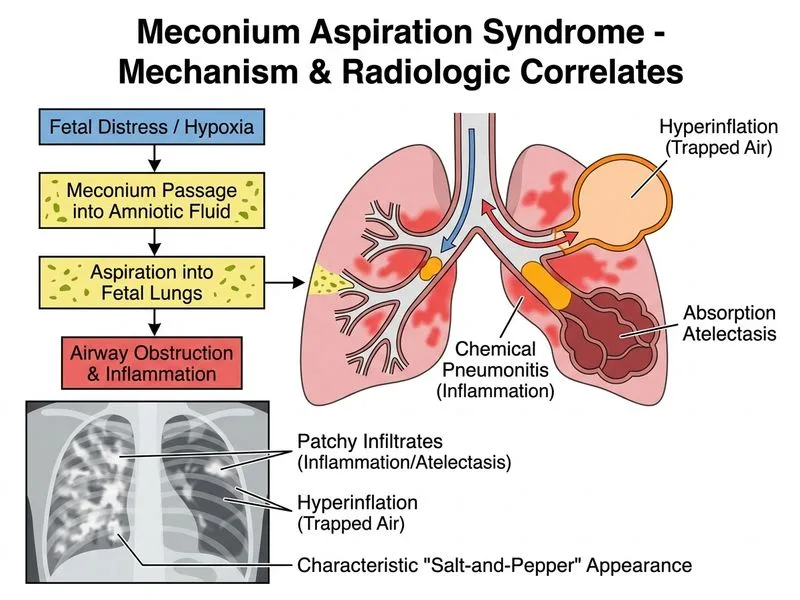
Which radiologic finding is MOST characteristic of meconium aspiration syndrome on chest X-ray?
A. Bilateral homogeneous ground-glass opacities
B. Lobar consolidation with air bronchograms
C. Hyperinflation with clear lung fields
D. Patchy infiltrates with areas of hyperinflation and atelectasis ("salt-and-pepper" appearance)
Explanation
Radiologic Features of Meconium Aspiration Syndrome
Characteristic CXR Appearance
Key Point
The "salt-and-pepper" or patchy appearance with alternating areas of hyperinflation and atelectasis is the MOST characteristic finding in MAS. This reflects the ball-valve obstruction mechanism — some alveoli are over-distended (air trapping) while others are collapsed (distal obstruction).
Classic Radiologic Findings in MAS
Table
Finding
Frequency
Mechanism
Patchy infiltrates (salt-and-pepper)
~60–70%
Ball-valve obstruction + atelectasis
Hyperinflation (flattened diaphragm, increased AP diameter)
~80%
Air trapping distal to obstruction
Barrel-shaped chest
~40%
Severe hyperinflation
Air leak (pneumothorax, pneumomediastinum)
~20–40%
Barotrauma from air trapping
Lobar consolidation
<10%
Aspiration of thick meconium
Why Not the Other Options?
High-YieldNEET PG
Ground-glass opacities are seen in RDS (surfactant deficiency), not MAS
Lobar consolidation suggests bacterial pneumonia or thick aspiration, not typical MAS
Hyperinflation alone with clear fields is seen in transient tachypnea of newborn (TTN), not MAS
Clinical Pearl
The CXR appearance can evolve — early films may show only hyperinflation, while later films (24–48 hours) develop the characteristic patchy infiltrates as chemical pneumonitis develops.
Nelson Textbook of Pediatrics 21e Ch 102
Loading illustration…
Practice similar questions
Sign up free to access AI-powered MCQ practice with detailed explanations and adaptive learning.