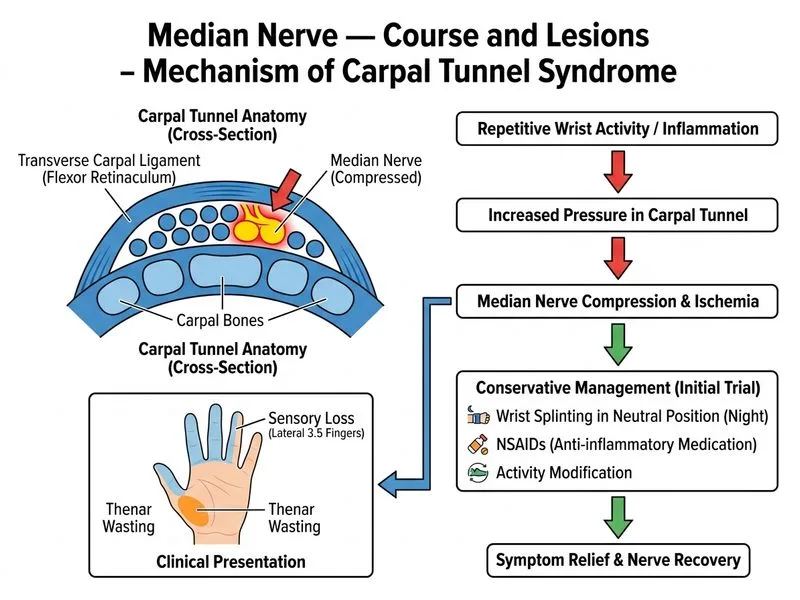
## Clinical Context This patient presents with **severe carpal tunnel syndrome (CTS)** — the most common entrapment neuropathy of the median nerve. The clinical findings include: - **Thenar wasting** (indicating established motor denervation) - **Weakness of thumb opposition and abduction** (progressive motor deficit) - **Sensory loss** over the lateral three and a half fingers - **Positive Phalen's test** - **Nerve conduction studies: prolonged distal motor latency of 6.2 ms** (normal <4.5 ms; severe CTS threshold >6.0 ms) and slowed conduction velocity across the wrist This constellation — particularly the **thenar atrophy** and **distal motor latency >6.0 ms** — classifies this as **severe CTS**, not mild-to-moderate disease. ## Severity Classification of CTS (American Academy of Neurology / AAOS Guidelines) | Severity | DML | Clinical Features | Management | |----------|-----|-------------------|------------| | Mild | <4.5 ms | Sensory symptoms only | Conservative | | Moderate | 4.5–6.0 ms | Sensory + mild motor | Conservative → Surgery if failed | | **Severe** | **>6.0 ms** | **Thenar atrophy, motor weakness** | **Surgical decompression** | ## Why Immediate Surgical Decompression? **Key Point:** Per AAOS, AAN, and standard neurosurgical guidelines, **severe CTS with thenar atrophy and distal motor latency >6.0 ms is an indication for surgical decompression (carpal tunnel release) without a mandatory trial of conservative management.** Delaying surgery in the presence of established motor denervation risks irreversible axonal loss and permanent thenar weakness. **High-Yield:** Indications for immediate surgical decompression in CTS: - Thenar muscle wasting/atrophy (established motor denervation) - Progressive motor weakness despite conservative measures - Distal motor latency >6.0 ms on NCS - Severe sensorimotor deficit - Acute CTS (e.g., post-fracture) **Clinical Pearl:** Conservative management (wrist splinting, NSAIDs) is appropriate for **mild-to-moderate CTS** of short duration without motor involvement. However, once **thenar atrophy** is present, conservative management is unlikely to reverse the structural nerve damage, and surgery offers the best chance of halting further deterioration and achieving functional recovery. (Reference: Aroori S & Spence RAJ, *Ulster Medical Journal*, 2008; AAOS Clinical Practice Guidelines for CTS, 2016) ## Why NOT the Other Options? **Conservative management (wrist splinting + NSAIDs)** is inappropriate here — thenar atrophy and DML >6.0 ms indicate severe, established disease. Conservative measures cannot reverse denervation and delay definitive treatment, risking permanent motor loss. **EMG** is unnecessary — NCS already confirms the diagnosis and severity (DML 6.2 ms). EMG would add information about denervation but would not change the management decision in a patient with overt thenar atrophy. **MRI of the wrist** is not indicated — there is no clinical suspicion of a space-occupying lesion, trauma, or atypical presentation. MRI would delay necessary surgical intervention without adding diagnostic value. ## Summary In a patient with **thenar atrophy + DML >6.0 ms**, the most appropriate next step is **immediate carpal tunnel release**, which has a 70–90% success rate in halting progression and improving motor function when performed before complete axonal degeneration.
Sign up free to access AI-powered MCQ practice with detailed explanations and adaptive learning.