
## Nuclear-Cytoplasmic Asynchrony in Megaloblastic Anemia ### Definition and Mechanism **Nuclear-cytoplasmic asynchrony** (also called **maturation dissociation**) is the hallmark morphologic feature of megaloblastic anemia. It reflects a mismatch between the maturity of the nucleus and the maturity of the cytoplasm. ### Why Cytoplasm Matures Faster Than Nucleus 1. **Cytoplasmic maturation** depends on: - Hemoglobin synthesis (normal in B12/folate deficiency) - Protein synthesis machinery (functional) - Mitochondrial function (intact) - These processes proceed at a normal or near-normal rate 2. **Nuclear maturation** depends on: - DNA synthesis (IMPAIRED due to defective dTMP synthesis) - Cell cycle progression (STALLED in S-phase) - Chromatin condensation (DELAYED) - These processes are severely slowed ### Result: Asynchrony - The cell accumulates hemoglobin and cytoplasmic proteins normally - But the nucleus remains large, open, and immature (fine chromatin pattern) - This creates the characteristic appearance: **large cell with immature nucleus and mature cytoplasm** **Key Point:** The nucleus is "left behind" while the cytoplasm matures normally. This is the opposite of iron deficiency (where cells are small and hypochromic—cytoplasm lags behind). **Mnemonic:** **"Mega-slow nucleus"** — the nucleus is mega-large and slow to mature; the cytoplasm is normal-paced. **High-Yield:** Megaloblastic changes appear in all rapidly dividing tissues (bone marrow, GI epithelium, respiratory epithelium) because they all depend on DNA synthesis. 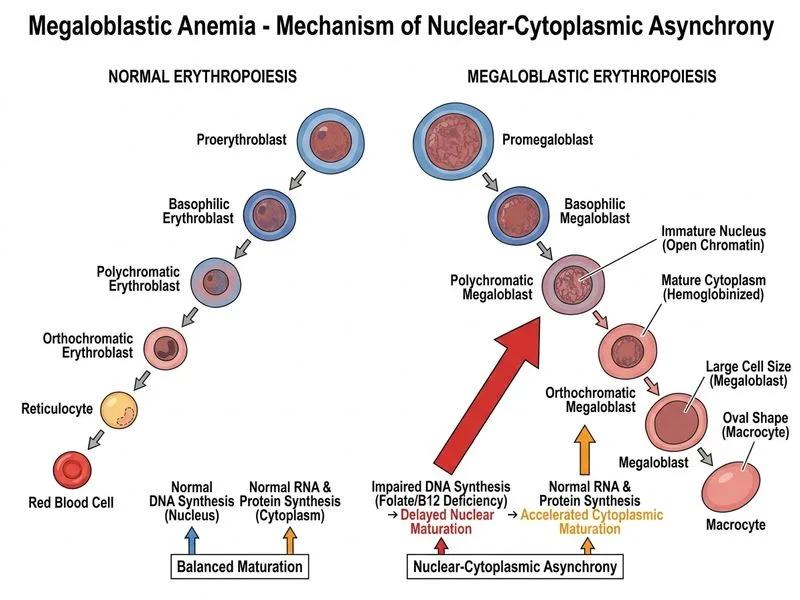
Sign up free to access AI-powered MCQ practice with detailed explanations and adaptive learning.