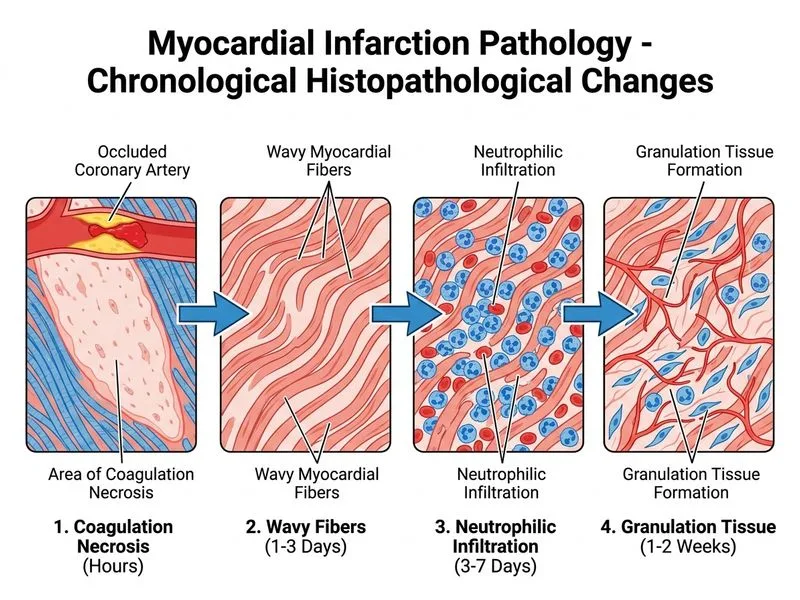
## Histopathological Timeline of Acute Myocardial Infarction **Key Point:** The sequence of morphological changes in acute MI follows a predictable timeline that correlates with the duration of infarction. ### Chronological Sequence | Time After Onset | Histopathological Finding | | --- | --- | | 0–30 minutes | No light microscopic changes (only EM/histochemical changes) | | 1–4 hours | **Wavy fibers** — earliest light microscopic change at the border zone | | 4–12 hours | **Coagulation necrosis** established; hypereosinophilic cytoplasm, nuclear pyknosis | | 12–24 hours | **Neutrophilic infiltration** begins at margins | | 1–3 weeks | **Granulation tissue** formation; macrophage infiltration and phagocytosis | | 3–8 weeks | Fibrosis and scar formation | **High-Yield:** The **earliest** light microscopic change in acute MI is **wavy fibers** — non-contractile dead myocytes at the border zone are passively stretched and buckled by the pull of adjacent viable myocytes, producing a wavy appearance visible within 1–4 hours. **Coagulation necrosis** (hypereosinophilia, nuclear loss) becomes established by 4–12 hours. **Neutrophilic infiltration** follows after 12–24 hours as the acute inflammatory response is mounted. **Granulation tissue** appears after approximately 1 week as healing begins. **Mnemonic:** **WCNG** = **W**avy fibers → **C**oagulation necrosis → **N**eutrophilic infiltration → **G**ranulation tissue. **Clinical Pearl:** Per Robbins Basic Pathology (10th ed.), wavy fibers are the hallmark of the earliest (1–4 hour) phase of MI visible on H&E staining. The presence of neutrophils is a useful marker to date an infarction to >12 hours old. Absence of neutrophils in a necrotic area suggests infarction <12 hours old. *Reference: Robbins Basic Pathology, 10th edition, Chapter 12 — The Heart.* 

Sign up free to access AI-powered MCQ practice with detailed explanations and adaptive learning.