A 3-day-old term neonate born to an O-positive mother presents with clinical jaundice. The mother is O-negative and unsensitized (indirect Coombs test negative at delivery). The infant's total serum bilirubin is 14 mg/dL. Which investigation is most appropriate to confirm hemolytic disease and guide management?
A. Reticulocyte count and peripheral blood smear
B. Transcutaneous bilirubinometry
C. Repeat indirect Coombs test on infant serum
D. Direct antiglobulin test (DAT/Coombs) on infant red blood cells
Explanation
Investigation of Choice for Suspected Hemolytic Jaundice
Clinical Context
This neonate has risk factors for hemolytic disease:
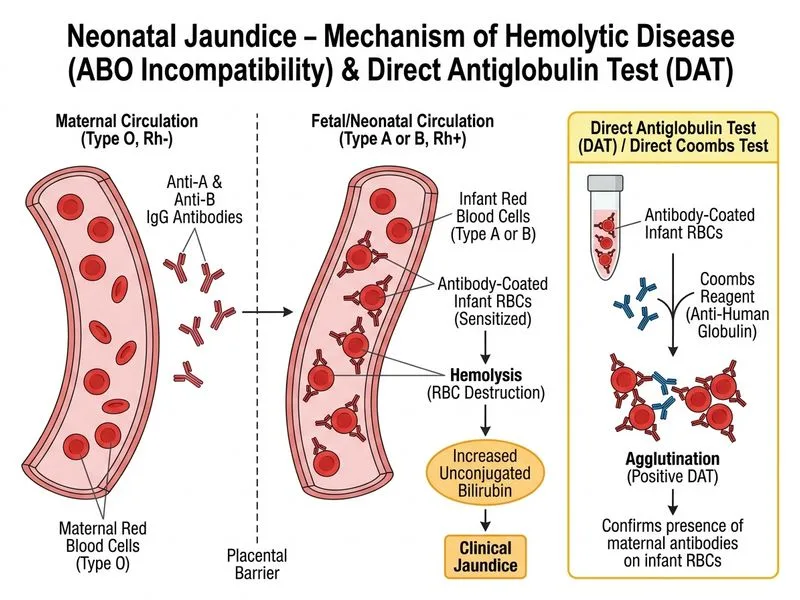
The DAT detects IgG antibodies bound directly to the surface of fetal/neonatal red blood cells, confirming in-vivo hemolysis.
High-YieldNEET PG
DAT is the gold standard confirmatory test for hemolytic disease of the newborn (HDN). A positive DAT in the presence of clinical jaundice and elevated bilirubin establishes hemolysis as the etiology.
Clinical Pearl
Even though the mother's indirect Coombs was negative (unsensitized), ABO incompatibility can still cause hemolysis because naturally occurring maternal IgG anti-A and anti-B antibodies cross the placenta. The infant's DAT will be positive.
Interpretation Algorithm
Loading diagram...
Comparison of Tests in Hemolytic Jaundice
Table
Investigation
Specificity
Timing
Role
DAT (Direct Coombs)
Confirms hemolysis
Stat
Gold standard; detects RBC-bound antibodies
Indirect Coombs (maternal)
Screens for alloimmunization
Antenatal/delivery
Negative does NOT exclude ABO incompatibility
Reticulocyte count
Reflects bone marrow response
Day 3–5
Elevated in hemolysis; supports diagnosis
Transcutaneous bilirubinometry
Non-invasive bilirubin estimate
Bedside
Screening tool; NOT diagnostic for hemolysis
Peripheral smear
Morphology
Day 3+
Shows spherocytes, polychromasia in hemolysis
Key Point
A positive DAT + elevated bilirubin + clinical jaundice = hemolytic disease until proven otherwise.
Park 26e Ch 11
Loading illustration…
Practice similar questions
Sign up free to access AI-powered MCQ practice with detailed explanations and adaptive learning.