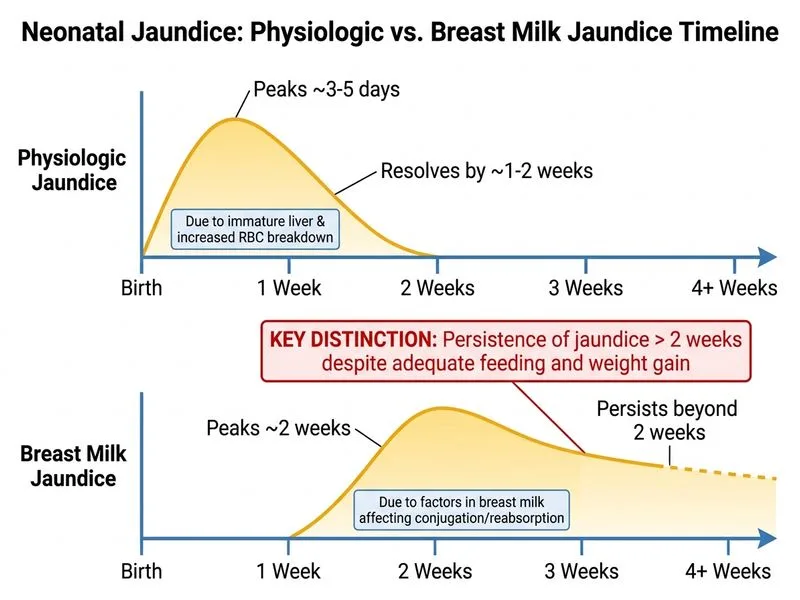
A 3-day-old Indian male neonate born to an O-positive mother presents with jaundice. Direct antiglobulin test is negative. Which feature best distinguishes physiologic jaundice from breast milk jaundice in this clinical context?
A. Persistence of jaundice beyond 2 weeks despite adequate feeding and weight gain
B. Absence of hemolysis on laboratory investigation
C. Peak bilirubin level occurring at 3–5 days of age
D. Appearance of jaundice on the second or third day of life
Explanation
Distinguishing Physiologic from Breast Milk Jaundice
Clinical Context
The negative DAT rules out hemolytic disease. Both physiologic jaundice and breast milk jaundice are non-hemolytic causes of neonatal hyperbilirubinemia. The key is to distinguish between them based on duration and feeding response.
Increase feeding frequency; may require supplementation
Prognosis
Self-limited, benign
Self-limited but may require intervention
Key Point
Key Point
Physiologic jaundice is a self-limited condition that resolves by 7–10 days in term infants with normal feeding. Breast milk jaundice persists beyond 2 weeks despite adequate feeding and weight gain, indicating that the breast milk itself (or inadequate intake) is perpetuating the hyperbilirubinemia.
Clinical Pearl
Clinical Pearl
The term "breast milk jaundice" is now preferred over "breastfeeding jaundice." Breast milk jaundice occurs in infants who are feeding well and gaining weight but still have elevated bilirubin beyond the second week. This suggests a component in breast milk (possibly high lipase or substances that increase enterohepatic circulation) is contributing to the jaundice.
High-Yield Distinction
High-YieldNEET PG
The duration beyond 2 weeks is the best discriminator. Physiologic jaundice resolves spontaneously by day 7–10; if jaundice persists beyond 2 weeks in a well-feeding, well-growing infant, breast milk jaundice should be suspected and further investigation (including TSH, direct/indirect bilirubin, and feeding assessment) is warranted.
Mnemonic
Mnemonic
PHYS = Physiologic jaundice resolves by day 7 (in term infants); BM = Breast Milk jaundice persists Beyond 2 weeks (Month-long).
Loading illustration…
Practice similar questions
Sign up free to access AI-powered MCQ practice with detailed explanations and adaptive learning.