
## Notochord and Its Derivatives The notochord is a transient mesodermal structure that appears during the third week of embryonic development and plays a crucial role in induction and organization of the embryo. ### Primary Derivative: **Nucleus pulposus** — The notochord gives rise to the nucleus pulposus of the intervertebral disc. This is the gel-like central core of the disc that provides shock absorption and flexibility to the vertebral column. ### Fate of the Notochord: - Most of the notochord regresses and disappears by the end of the 8th week - The portion that persists gives rise to the nucleus pulposus - Small remnants may persist as: - **Notochordal remnants** (rare, may form notochordal cysts) - Source of rare notochordal tumors (chordoma) in adulthood ### Clinical Pearl: **Chordoma** — A rare malignant tumor arising from notochordal remnants. Most commonly occurs in the sacrococcygeal region or clivus (base of skull). This is a high-yield fact for NEET PG exams. ### Key Point: The notochord is essential for: - Induction of the neural plate (via secretion of signaling molecules) - Development of the vertebral column - Formation of the nucleus pulposus After its primary inductive role, most of the notochord undergoes apoptosis, leaving only the nucleus pulposus as its main structural derivative. 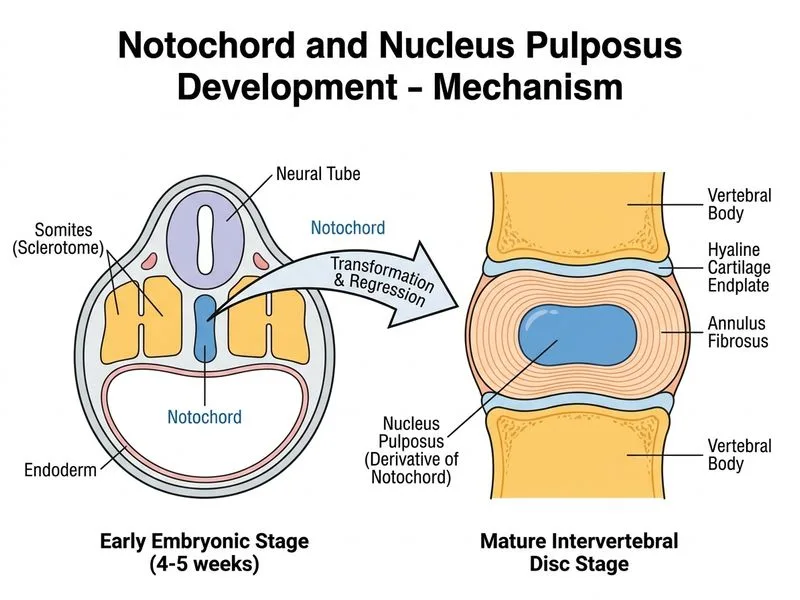
Sign up free to access AI-powered MCQ practice with detailed explanations and adaptive learning.