
## Notochord Function in Early Embryology The **notochord** is a transient mesodermal structure that arises from the primitive node (Hensen's node equivalent in humans) during the third week of development. Its primary embryological significance lies in its **inductive role**. ### Key Inductive Functions: **Correct Answer: The neural tube and vertebral column** - The notochord secretes **sonic hedgehog (Shh)** and other signaling molecules (FGF, Wnt inhibitors) that induce the overlying ectoderm to form the **neural tube** (primary neurulation). - The notochord also induces surrounding mesenchyme to form the **vertebral bodies and intervertebral discs** (nucleus pulposus). - By 8–12 weeks, the notochord regresses, but its remnants persist as the **nucleus pulposus** of the intervertebral disc. ### Clinical Pearl: **Notochordal remnants** can give rise to **chordoma** (a rare malignant tumor of the spine and sacrococcygeal region), typically presenting in adults. ### High-Yield Mnemonic: **"Notochord = Neuro-inducer + Nucleus"** — it induces neural tube formation and becomes the nucleus pulposus. 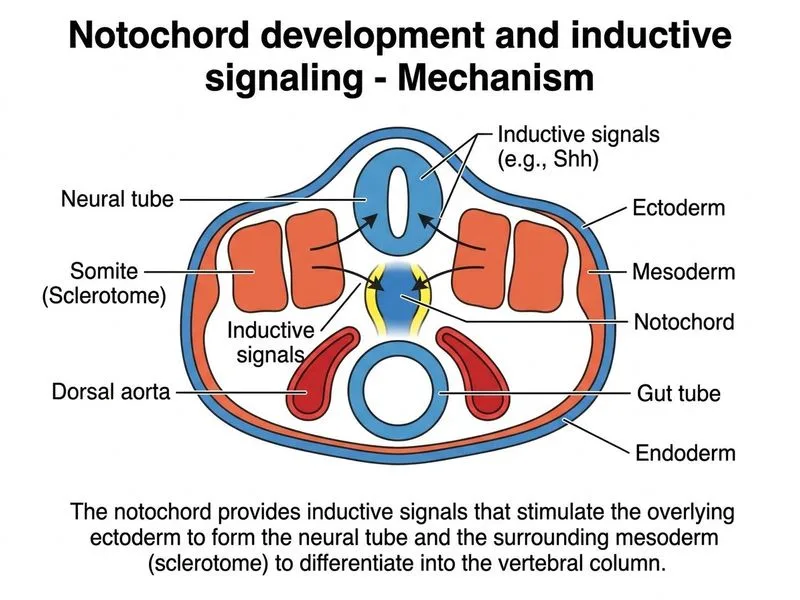
Sign up free to access AI-powered MCQ practice with detailed explanations and adaptive learning.