
## Notochord Embryological Origin **Correct Answer: Primitive pit and primitive node** The notochord is derived from the **epiblast** cells that invaginate through the **primitive pit** during the second week of development. These cells migrate cranially from the primitive node (also called the primitive knot, equivalent to Hensen's node in avian embryos) and form a midline structure between the epiblast and hypoblast. ### Key Points: - **Timing:** Develops during the 2nd week of human embryonic development - **Fate:** The notochord serves as an **organizer** for surrounding tissues, particularly in inducing the development of the neural tube and vertebral bodies - **Later fate:** Most of the notochord regresses; remnants persist as the **nucleus pulposus** of the intervertebral disc - **Germ layer origin:** Although the notochord arises from epiblast cells, it is considered a **chordamesoderm** structure and is distinct from the three primary germ layers ### Clinical Relevance: Abnormal notochord development can lead to: - Notochordal remnants (chordomas—rare malignant tumors of the sacrococcygeal region) - Vertebral anomalies - Spina bifida variants 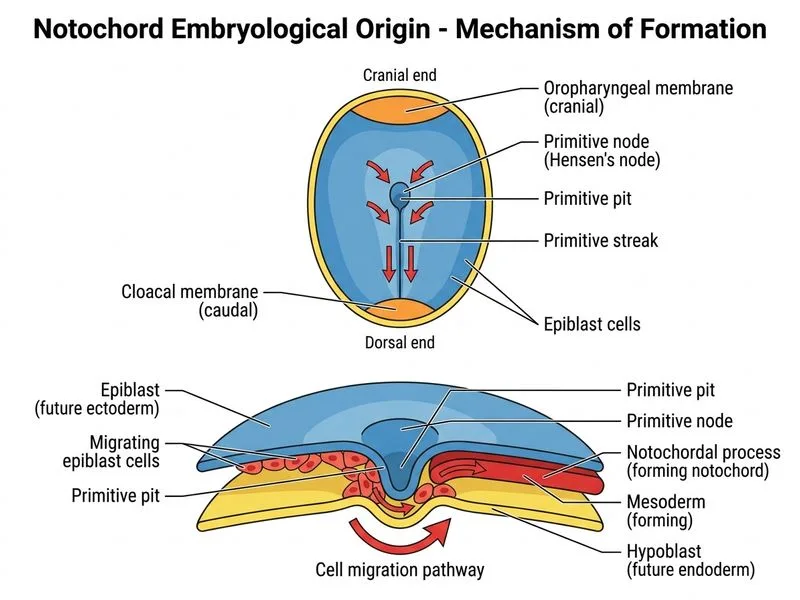
Sign up free to access AI-powered MCQ practice with detailed explanations and adaptive learning.