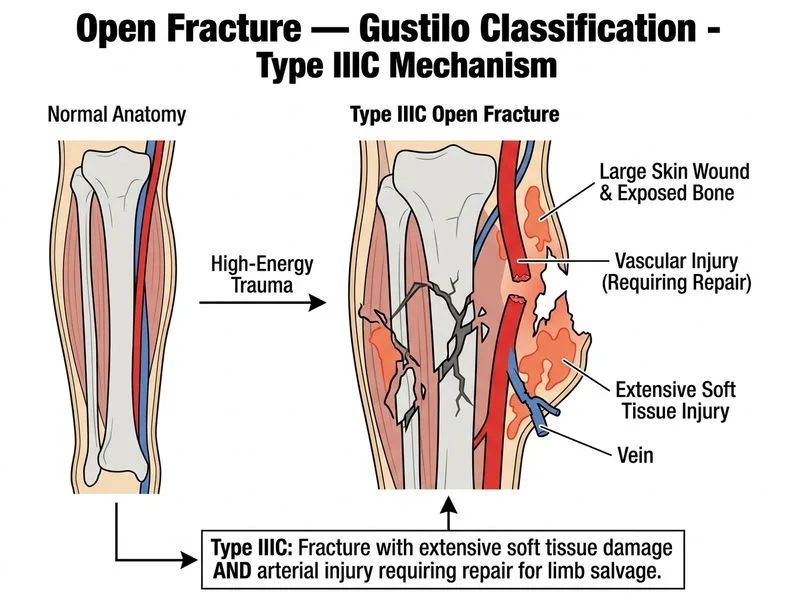
## Gustilo-Anderson Classification of Open Fractures **Key Point:** Type IIIC is defined by the presence of vascular injury requiring repair, regardless of the degree of soft tissue damage or contamination. ### Type III Subdivisions | Grade | Soft Tissue Injury | Contamination | Vascular Status | Prognosis | |-------|-------------------|----------------|-----------------|----------| | **IIIA** | Extensive but adequate coverage | High | Intact | Better | | **IIIB** | Extensive with periosteal stripping | High | Intact | Guarded | | **IIIC** | Variable | Variable | **Vascular injury requiring repair** | **Poor** | **High-Yield:** Type IIIC is the most serious category because vascular compromise threatens limb viability. The presence of vascular injury is the defining criterion, not the extent of soft tissue damage. **Clinical Pearl:** Type IIIC fractures have the highest amputation rates (up to 50%) and require urgent vascular surgery consultation alongside orthopedic management. Vascular repair must be attempted within 6–8 hours for optimal limb salvage. **Mnemonic:** **VASCULAR = IIIC** — if there's a vascular injury in an open fracture, it's automatically Type IIIC, the most severe category. 
Sign up free to access AI-powered MCQ practice with detailed explanations and adaptive learning.