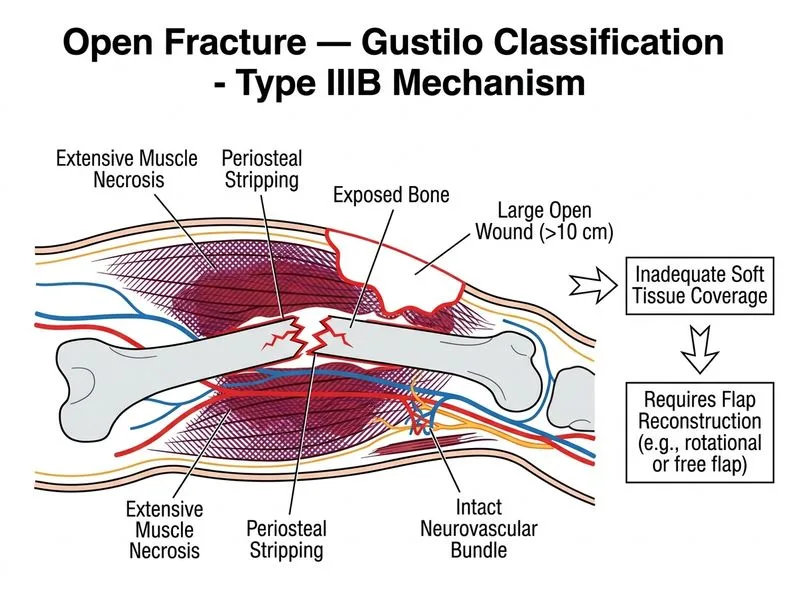
A 28-year-old farmer is brought to the emergency department after his leg is caught in a threshing machine. Examination reveals a 15 cm laceration over the right femur with extensive muscle necrosis, periosteal stripping, and exposed bone. The soft tissue damage is so severe that primary closure is impossible. Distal pulses are palpable and sensation is intact. What is the Gustilo classification, and what is the primary determinant of this classification?
A. Type IIIA; extensive soft tissue damage is the primary determinant
B. Type II; wound size is the primary determinant
C. Type IIIB; inability to achieve soft tissue coverage without a flap is the primary determinant
D. Type IIIC; the mechanism of injury (farm machinery) is the primary determinant
Explanation
Gustilo Type IIIB: Severe Open Fracture with Compromised Coverage
Definition and Diagnostic Criteria
Key Point
Type IIIB is defined by massive soft tissue injury with periosteal stripping such that soft tissue coverage cannot be achieved without a flap procedure (muscle flap, fasciocutaneous flap, or free flap). The wound size is typically >10 cm, but size alone does not define IIIB; the critical feature is the extent of tissue loss and inability to close primarily or with simple grafting.
Distinguishing Type IIIA from Type IIIB
Table
Feature
Type IIIA
Type IIIB
Wound size
>10 cm
>10 cm
Bone exposure
Yes
Yes
Periosteal stripping
Minimal to moderate
Extensive
Soft tissue coverage
Possible without flap
Requires flap
Muscle viability
Mostly viable
Extensive necrosis
Infection risk
10–15%
15–50%
Amputation rate
~5–10%
~20–50%
Analysis of This Case
Present findings:
Wound size: 15 cm (>10 cm)
Periosteal stripping: Explicitly stated (hallmark of IIIB)
Soft tissue coverage: Impossible without flap (defines IIIB)
Vascular status: Intact (distal pulses palpable → not Type IIIC)
Nerve status: Intact (sensation intact → not Type IIIC)
High-YieldNEET PG
The presence of periosteal stripping is the single most important feature distinguishing Type IIIB from Type IIIA. Periosteal stripping compromises bone blood supply, dramatically increasing infection risk and non-union rates.
Why This Is NOT Type IIIC
Warning
Type IIIC is defined solely and exclusively by vascular injury requiring repair. It is independent of soft tissue damage. This patient has intact distal pulses and no vascular injury, so despite severe soft tissue damage, the classification is IIIB, not IIIC.
Clinical Pearl
A Type II fracture with vascular injury requiring repair is reclassified as Type IIIC. Conversely, a Type IIIB with intact vasculature remains IIIB, not IIIC.
Management Implications for Type IIIB
1.
Immediate debridement within 3–6 hours (remove all non-viable tissue)