Open Fracture — Gustilo Classification MCQ — NEET PG Practice Question | NEETPGAI
Open Fracture — Gustilo Classification
hard
bone Orthopedics
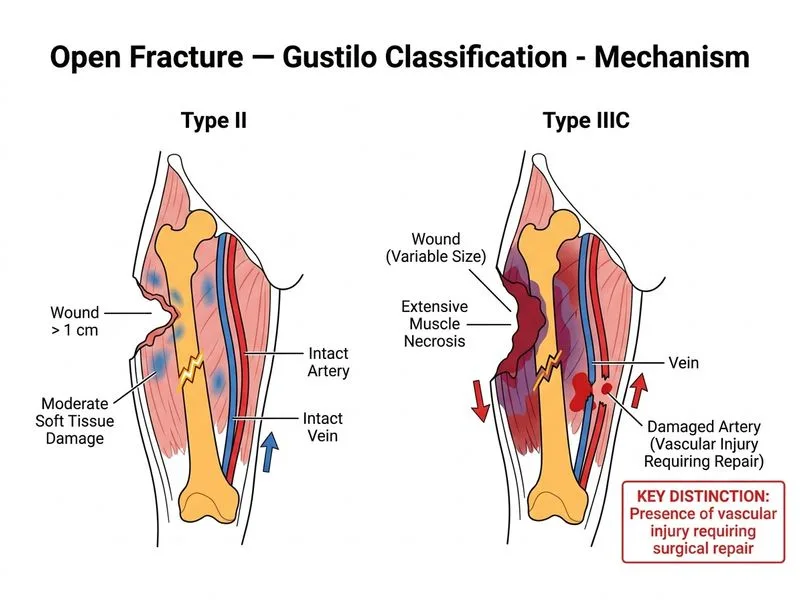
Two patients present with open fractures of the femur. Patient A has a 2 cm laceration with moderate muscle contusion and no vascular injury. Patient B has a 12 cm wound with extensive muscle necrosis and a devascularized limb requiring vascular repair. Which finding best distinguishes Patient B's injury as Gustilo Type IIIC rather than Patient A's Type II?
A. Moderate soft tissue contusion without devascularization
B. Presence of vascular injury requiring surgical repair
C. Absence of gross contamination from the environment
D. Wound size greater than 10 cm
Explanation
Gustilo Type II vs Type IIIC: The Vascular Injury Discriminator
While wound size and soft tissue damage differentiate Type I from Type II, vascular injury is the critical feature that defines Type IIIC and distinguishes it from Type IIIA and IIIB.
Type III Subtypes: Vascular Injury as the Defining Criterion
Key Point
Type IIIC is defined by the presence of vascular injury requiring surgical repair — regardless of soft tissue damage or wound size.
Table
Type III Subtype
Soft Tissue Damage
Vascular Injury
Prognosis
IIIA
Extensive, but viable
Absent
Limb salvageable
IIIB
Extensive, devascularized
Absent (or minor)
High amputation rate
IIIC
Any degree
Present — requires repair
Amputation common
High-YieldNEET PG
Type IIIC is the only open fracture subtype that mandates vascular surgery involvement. The presence of vascular injury requiring repair is the single best discriminator between Type II (no vascular injury) and Type IIIC (vascular injury present).
Clinical Significance
Clinical Pearl
A Type IIIC fracture has a significantly worse prognosis than Type IIIA or IIIB, even if soft tissue damage is less extensive. Vascular injury implies limb-threatening ischemia and high amputation rates (>50% in many series).
Mnemonic
VIC for Type IIIC: Vascular injury, Injury requiring repair, Critical limb threat.
Warning
Do not confuse "extensive soft tissue damage" (Type IIIB) with "vascular injury" (Type IIIC). A Type IIIB fracture may have severe devascularization of muscle but an intact vascular tree; Type IIIC has actual vascular injury that requires operative repair.
Rockwood & Green's Fractures in Adults 9e Ch 12
Loading illustration…
Practice similar questions
Sign up free to access AI-powered MCQ practice with detailed explanations and adaptive learning.