Orbital Cellulitis MCQ — NEET PG Practice Question | NEETPGAI
Orbital Cellulitis
medium
eye Ophthalmology
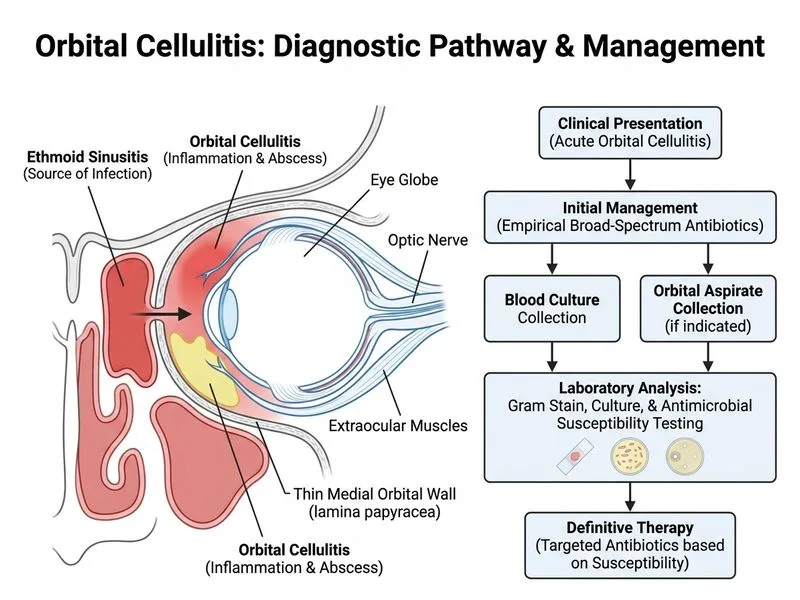
A 42-year-old woman with acute orbital cellulitis secondary to ethmoid sinusitis is started on empirical broad-spectrum antibiotics. Blood cultures and orbital aspirate are obtained. Which investigation is most specific for identifying the causative organism and guiding definitive antibiotic therapy?
A. Orbital tissue biopsy with histopathology
B. Rapid PCR panel for common respiratory pathogens from blood
C. Serology for Staphylococcus aureus toxins
D. Gram stain and culture of blood and orbital aspirate with antimicrobial susceptibility testing
Explanation
Microbiological Diagnosis in Orbital Cellulitis
Gold Standard for Organism Identification
Key Point
Gram stain and culture of blood and orbital aspirate with antimicrobial susceptibility testing (AST) is the most specific investigation because it:
Directly identifies the causative organism
Provides susceptibility data for targeted antibiotic selection
Guides de-escalation from empirical therapy
Allows detection of resistance patterns (e.g., MRSA, β-lactamase production)
Microbiology of Orbital Cellulitis
Table
Organism
Frequency
Source
Key Feature
Staphylococcus aureus
30–40%
Skin, sinuses
May be MRSA; toxin-mediated
Streptococcus pneumoniae
20–25%
Sinuses, respiratory
Gram-positive diplococci
Streptococcus pyogenes
10–15%
Skin, sinuses
Gram-positive chains
Anaerobes
10–20%
Sinuses, dental
Require anaerobic culture
Gram-negative rods
5–10%
Sinuses, GI
Pseudomonas in immunocompromised
High-YieldNEET PG
In sinusitis-derived orbital cellulitis (as in this case), the most common organisms are S. aureus, S. pneumoniae, and anaerobes. Culture with AST is essential because:
1.
Empirical therapy covers broad spectrum but is not organism-specific